How to Become a BAS Technician: A Practical Roadmap for HVAC, Electrical, and IT Beginners
Building automation technicians sit in an unusual place between trades.
A BAS technician may troubleshoot a temperature sensor in the morning, an MS/TP trunk at lunch, a VFD command problem in the afternoon, and a Niagara station before going home.
That mix is what makes the career interesting – and what makes the entry path confusing. There is no single North American license called 'BAS Technician' that automatically qualifies someone for every controls job.
Quick Answer
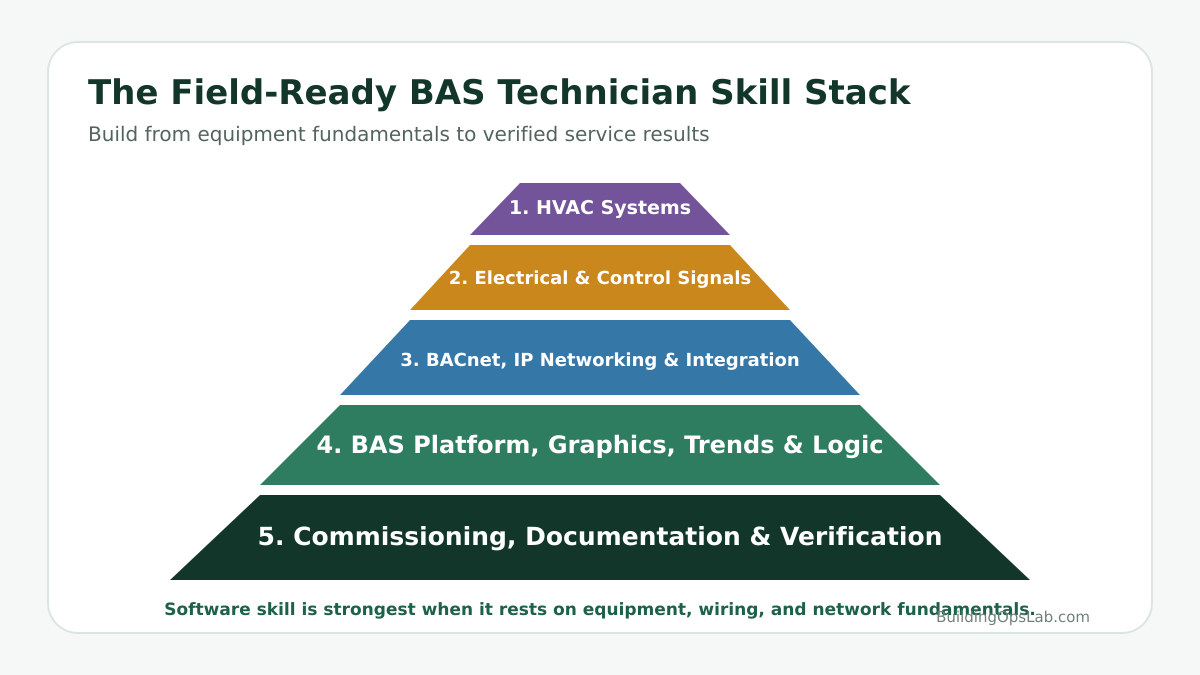
A strong entry path is to build skills in this order:
- Commercial HVAC fundamentals
- Basic electricity and control circuits
- DDC and control sequences
- Networking fundamentals
- BACnet and other building protocols
- One major BAS platform
- Commissioning and troubleshooting
- Documentation and customer communication
You do not need to master every controls brand before applying for a junior role. You do need enough HVAC and electrical understanding to make sense of what the software is controlling.
1. Learn What the Equipment Is Supposed to Do
Controls troubleshooting becomes much easier when you understand the mechanical system. Learn the operating purpose of AHUs, RTUs, VAV boxes, boilers, chillers, pumps, cooling towers, heat exchangers, and hydronic loops.
You do not have to become a refrigeration mechanic first, but you should understand concepts such as airflow, heat transfer, valve position, fan and pump operation, supply/return temperatures, and safety interlocks.
The U.S. Bureau of Labor Statistics notes that modern HVAC work increasingly involves computerized components and networking. That overlap is one reason HVAC experience transfers well into controls.
2. Get Comfortable With Low-Voltage Electricity
BAS technicians routinely work around transformers, relays, dry contacts, analog signals, digital outputs, transducers, actuators, and VFD interfaces.
You should be able to read a wiring diagram, distinguish command from feedback, understand normally open versus normally closed contacts, and use a meter safely within the limits of your training and authorization.
Higher-voltage electrical work and regulated trade work remain subject to local licensing and site safety rules.
3. Learn Control Logic Before Learning Fancy Graphics
A good graphic can hide a bad sequence. Focus first on the logic underneath it.
- Enable/disable conditions
- Occupied/unoccupied modes
- Heating and cooling calls
- Interlocks and permissives
- Lead/lag sequencing
- PI/PID control
- Alarms and delays
- Reset strategies
ASHRAE provides controls resources ranging from fundamentals to Guideline 36 high-performance sequences. Even if you never design a full sequence from scratch, reading control intent will make you a better service technician.
4. Learn Networking Earlier Than Most HVAC Technicians Do
Modern BAS service work regularly crosses into IP networks. Learn IP addresses, subnet masks, gateways, switches, VLAN concepts, ports, and the difference between local network reachability and application-level communication.
You do not need to become a network engineer, but you should be able to separate 'the controller has no power,' 'the IP network is down,' and 'the BAS service is not communicating.'
5. Learn BACnet Properly
BACnet is widely used across building automation. The BACnet Institute provides free self-paced learning, including BACnet Basics and facility-manager-oriented BAS courses with certificates of completion.
Start with Device Instance, Network Number, MS/TP MAC address, BACnet/IP, MS/TP, routers, BBMD concepts, and command priorities. These fundamentals transfer across many control brands.
6. Pick One BAS Platform and Go Deep
Once you understand general controls, learn one platform well enough to build and troubleshoot a real project.
Niagara is one common choice because it is used across many OEM brands. Tridium University offers Niagara training and certification through Tridium and certified training partners. Other employers may prioritize their own manufacturer platform.
The goal is not to collect five software certificates before you have touched a controller. Learn how one platform handles points, logic, histories, alarms, schedules, networks, users, and backups.
7. Learn Commissioning – Not Just Programming
Programming a point does not prove the equipment works. Commissioning means checking the entire chain from software command to physical response and back to feedback.
Practice questions such as:
- Does the actuator move when commanded?
- Does the fan status actually prove operation?
- Does the sensor agree with a field measurement?
- Does the VFD stop as well as start?
- Does the schedule own the final command?
- Does the alarm appear under the intended condition?
8. Build Troubleshooting Habits
The fastest technicians are usually not the ones who know the most parameter numbers from memory. They are the ones who can reduce a large problem into smaller layers.
Power → network → controller → program → output → equipment → feedback is a repeatable troubleshooting path for many BAS problems.
9. Document Your Work
Controls work is difficult to hand off when nobody records what changed. Write clear service notes, label wiring, save backups, capture original parameter values, and describe how you verified the repair.
Good documentation is also one of the fastest ways to prove to an employer that you are ready for more responsibility.
A U.S. and Canada Reality Check
BAS job titles and licensing boundaries vary. In the United States, refrigerant work can trigger EPA Section 608 requirements, while electrical licensing is state or local. In Canada, refrigeration and air-conditioning is a Red Seal trade across many provinces and territories, but BAS work can also be performed by controls specialists whose role does not match one single national trade credential.
Before performing regulated electrical or refrigeration work, follow the rules for the jurisdiction and employer. BAS knowledge does not replace a required trade license.
Do You Need an HVAC Background?
No single background is mandatory. People enter BAS from HVAC, electrical, electronics, IT/networking, engineering technology, and facilities operations.
HVAC entrants often understand equipment but need networking and software. IT entrants may understand networks but need mechanical sequences. Electricians may be strong with wiring and panels but need hydronics and HVAC control logic.
The best path is to identify your gap and deliberately fill it.
Field Case: One Offline Controller Required Five Skill Areas
At one commercial building, an area controller had been offline since approximately November of the previous year. Local testing showed that the controller itself was operational and its readings were normal. The communication LEDs showed transmit activity but no receive activity, so replacing the controller immediately would have ignored the stronger evidence.
The communication wiring was traced through a Carrier controller. Testing identified a bad communication connection, which was reconnected. A duplicate network-number setting on the MS/TP path was also corrected. Communication returned after the wiring and configuration issues were addressed.
That single call required equipment awareness, low-voltage wiring, MS/TP fundamentals, controller configuration, and final verification. It is a practical example of why BAS is not simply programming graphics. A new technician should learn to move methodically from the server symptom to the local controller, physical network, configuration, and confirmed result.
A Practical First-Year Learning Checklist
[ ] Read one AHU sequence of operation and trace it in the BAS
[ ] Commission a temperature sensor from field device to graphic
[ ] Trace one fan start command through controller, relay/VFD, and feedback
[ ] Troubleshoot one BACnet MS/TP device
[ ] Build or modify a simple PI/PID loop under supervision
[ ] Create and verify a schedule and alarm
[ ] Back up and restore a controller/station in a training environment
[ ] Write a service note that another technician can follow
Key Takeaways
- BAS is a hybrid career: HVAC + controls + electrical + networking + software.
- Learn mechanical systems before trying to solve everything from a graphic.
- BACnet and IP networking are core service skills.
- One platform learned deeply is more useful than superficial exposure to many platforms.
- Commissioning and documentation separate a programmer from a field-ready technician.
FAQ
Do I need a college degree to become a BAS technician?
Not universally. Employers hire from trade schools, apprenticeships, HVAC/electrical backgrounds, engineering technology programs, and experienced facility teams. Job requirements vary.
Is Niagara certification required?
Not for every BAS job. It is highly relevant when the employer or project uses Niagara, and Tridium notes that Niagara certification is typically required on Niagara-based BAS projects.
Is BAS mostly programming?
No. Field troubleshooting, wiring, sensors, networking, commissioning, documentation, and customer interaction are major parts of many BAS technician roles.
Can an HVAC technician move into BAS?
Yes. HVAC knowledge is a strong foundation. The main additional skills are usually DDC logic, networking, communication protocols, and a BAS software platform.
Related Articles
Sources & Further Reading
- Tridium University – Niagara Training and Certification
- BACnet International – The BACnet Institute
- U.S. Bureau of Labor Statistics – HVAC Mechanics and Installers
- Red Seal – Refrigeration and Air Conditioning Mechanic
- ASHRAE – Building Controls Resources
Disclaimer: This article provides general commercial HVAC and building-automation information. Always follow manufacturer documentation, site-specific procedures, applicable codes, licensing rules, and safety requirements.