BAS Technician vs HVAC Technician: What’s the Difference – and Which Career Fits You?
A BAS technician and an HVAC technician can stand in front of the same air handler and see two different systems.
The HVAC technician may be thinking about airflow, compressors, motors, refrigerant, bearings, belts, filters, and mechanical condition.
The BAS technician may be thinking about sensors, commands, interlocks, network communication, VFD references, controller logic, schedules, and why the graphic does not match the field.
Both views matter. Commercial HVAC increasingly depends on computerized controls and networked equipment, so the boundary between the two careers is becoming more connected rather than less.
Quick Answer
HVAC technicians primarily install, maintain, and repair mechanical HVACR systems. BAS technicians primarily install, program, integrate, commission, and troubleshoot the controls and communication systems that operate that equipment.
The best commercial service technicians often understand enough of both disciplines to know when a problem belongs on the mechanical side and when it belongs on the controls side.
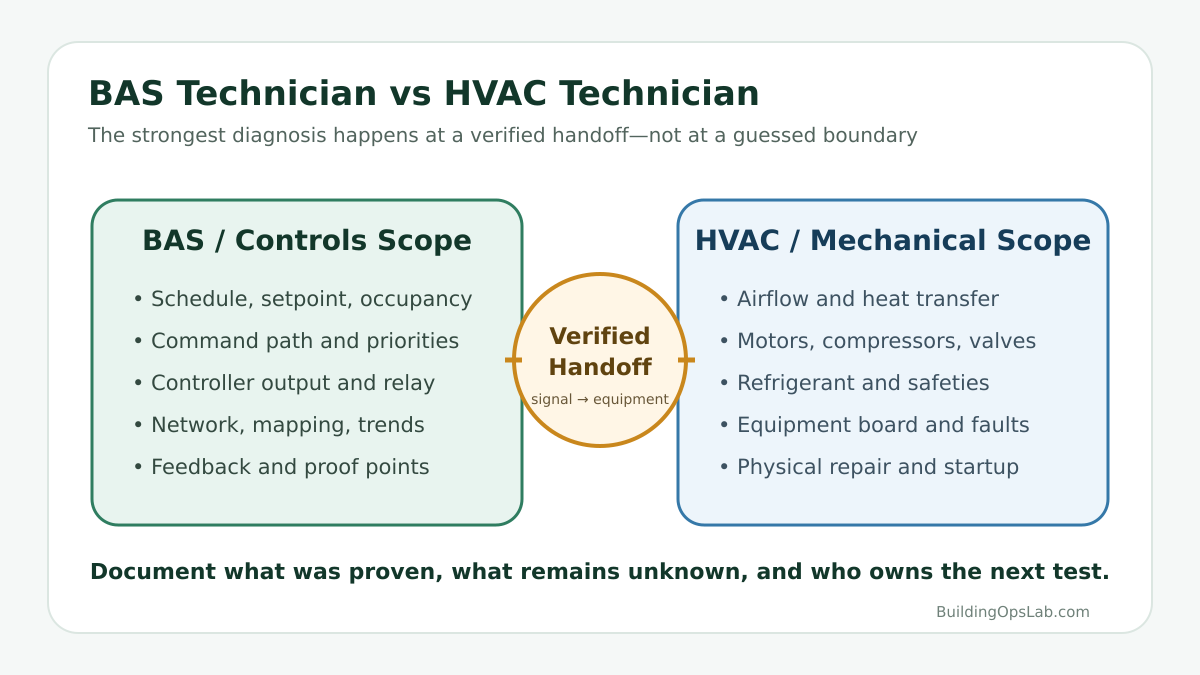
What an HVAC Technician Usually Owns
- Mechanical equipment condition
- Refrigeration circuits where licensed/certified
- Motors, fans, compressors, heat exchangers, and coils
- Airflow and mechanical performance
- Preventive maintenance and repair
- Electrical troubleshooting within trade scope
- Manufacturer-specific equipment service
The U.S. Bureau of Labor Statistics describes HVAC technicians as workers who install, maintain, repair, inspect, and test HVACR systems and components. Modern technicians also encounter computerized components and networking features.
What a BAS Technician Usually Owns
- DDC controllers and I/O
- Control sequences and programming
- Sensors and actuator commands
- BACnet and other network integration
- BAS graphics, trends, alarms, and schedules
- VFD and packaged-equipment integration
- Commissioning and functional testing
- Supervisor/JACE/server communication
The exact scope depends heavily on the employer. A controls contractor, manufacturer branch, facilities department, and system integrator may all use the title 'BAS Technician' differently.
Same Complaint, Different Troubleshooting Path
Complaint: 'The room is too warm.'
An HVAC technician may investigate:
- Airflow
- Filter and coil condition
- Mechanical cooling
- Refrigerant circuit
- Fan/motor operation
A BAS technician may investigate:
- Zone temperature and setpoint
- Cooling command
- VAV airflow and damper
- Valve command/feedback
- Occupancy schedule
- Network status and overrides
Neither list is complete. The point is that the same symptom can cross disciplines.
Field Case: Where BAS Diagnosis Handed Off to HVAC
During one compressor no-start investigation, the BAS technician verified that the controller command changed and measured the start/stop relay voltage at the equipment. The relay output followed the BAS command, so the immediate fault boundary moved beyond the BAS output and into the equipment-side control chain.
The HVAC-side investigation then followed the compressor control board, its fault indication, the associated FP1/FP2 protection inputs, and field wiring. After wiring checks and reconnection of the Y control connection, the compressor started and was monitored. The follow-up recommendation remained conditional on whether the fault returned.
This is what a professional handoff should look like: the controls technician documents the command and physical output that were proven, the HVAC technician investigates the mechanical equipment and safeties, and both sides verify the final response. The handoff is based on evidence, not on saying “the BAS is fine” or “the RTU is bad.”
Tools: Mechanical vs Controls
Typical HVAC-side tools may include:
- Refrigeration gauges and service tools
- Electrical meter
- Airflow and temperature instruments
- Hand tools
- Manufacturer service software
Typical BAS-side tools may include:
- Laptop with manufacturer/BAS software
- Network tools
- Electrical meter
- Pressure/temperature reference instruments
- BACnet diagnostic tools
- Trend and data-analysis tools
There is significant overlap. A BAS technician who cannot verify a field signal is limited, and an HVAC technician who cannot interpret a modern controller can be limited on advanced equipment.
Which Job Has More Programming?
BAS roles generally involve more direct programming, database work, point mapping, graphics, and network configuration.
HVAC technicians may also configure sophisticated factory controllers, VFDs, thermostats, and packaged equipment. BLS specifically identifies technology skills as increasingly important in HVAC because modern systems contain computerized controls and networking.
Which Job Requires More Mechanical Knowledge?
HVAC technicians typically go deeper into mechanical and refrigeration service. BAS technicians still need enough mechanical understanding to know whether the sequence makes sense and whether the equipment can physically do what the software is requesting.
Which Career Is Better for Someone From IT?
BAS may feel more familiar because networking, software, servers, IP addressing, and cybersecurity concepts are increasingly important. The gap to close is usually mechanical HVAC knowledge and electrical field work.
Which Career Is Better for Someone From HVAC?
Moving from commercial HVAC into BAS is a common technical progression because the mechanical foundation is already there. The new learning areas are DDC programming, networking, protocols, and software.
Licensing and Certification Are Not the Same
A BAS certificate does not automatically authorize regulated refrigeration or electrical work. In the United States, technicians who perform refrigerant service covered by Section 608 must hold the required EPA certification. In Canada, refrigeration and air-conditioning is a Red Seal trade in participating provinces and territories.
Controls work itself may fall under different electrical, low-voltage, contractor, or site rules depending on jurisdiction. Always separate 'I know how to program it' from 'I am legally authorized to perform this work.'
What About Pay?
There is no single reliable national 'BAS technician' wage series that maps cleanly to every controls job, so comparing one BAS salary number with the BLS HVAC number can be misleading.
Pay varies by controls platform, travel, commissioning responsibility, union status, region, overtime, project engineering duties, and whether the role is field service, construction, programming, or management.
For career planning, compare actual local job postings and responsibilities rather than relying on a generic BAS-versus-HVAC salary chart.
The Hybrid Technician Advantage
A technician who can move between the mechanical system and the control system can shorten troubleshooting dramatically.
For example, if a pump speed keeps oscillating, a hybrid technician can ask whether the VFD is failing, whether the BAS command is oscillating, whether the pressure sensor is unstable, and whether the hydronic system is changing load – instead of assuming the first visible component is the cause.
That does not mean one person should perform work outside their training or license. It means cross-disciplinary understanding improves diagnosis.
Which Career Fits You?
BAS may fit you if you enjoy:
- Programming and logic
- Networking and communication protocols
- Trend analysis
- Commissioning
- Finding why several systems are interacting incorrectly
HVAC may fit you if you enjoy:
- Mechanical troubleshooting
- Refrigeration and equipment service
- Hands-on repair
- Airflow and system performance
- Working directly on HVAC machinery
If both lists sound good, commercial controls and advanced HVAC service are exactly where the two careers overlap.
Key Takeaways
- HVAC technicians focus more deeply on the mechanical equipment; BAS technicians focus more deeply on the controls and communication layers.
- Both careers increasingly require electrical and technology skills.
- BAS technicians still need HVAC fundamentals, and advanced HVAC technicians increasingly need controls literacy.
- Licensing requirements depend on the actual work being performed, not the job title.
- A hybrid mechanical-controls skill set is especially useful for commercial troubleshooting.
FAQ
Can a BAS technician work on refrigerant systems?
Only when the technician also meets the applicable regulatory and licensing requirements. BAS credentials alone do not replace refrigerant-handling certification.
Do HVAC technicians program BAS systems?
Some do, particularly in commercial service roles. Others work mainly on mechanical equipment. Employer scope and training vary widely.
Which career is more computer-based?
BAS work usually involves more laptops, programming, databases, and networking, although modern HVAC service also uses computerized diagnostics and controls.
Can I move from HVAC to BAS later?
Yes. Commercial HVAC experience provides a strong mechanical foundation for learning DDC, BACnet, networking, and BAS platforms.
Related Articles
Sources & Further Reading
- U.S. Bureau of Labor Statistics – HVAC Mechanics and Installers
- U.S. Department of Energy – About Building Controls
- Tridium University – Niagara Training
- Red Seal – Refrigeration and Air Conditioning Mechanic
Disclaimer: This article provides general commercial HVAC and building-automation information. Always follow manufacturer documentation, site-specific procedures, applicable codes, licensing rules, and safety requirements.