Best Certifications for BAS and HVAC Controls Technicians: What Actually Matters
Search for ‘best BAS certification’ and you can quickly end up with a long list of courses, certificates, trade licenses, product certifications, and manufacturer training that are not equivalent.
The most important distinction is this: a training certificate may prove that you completed a course; a trade credential may authorize or recognize a regulated scope; and a vendor certification may qualify you to work on a specific platform.
There is no single credential that makes someone a complete BAS technician.
Quick Answer
For most commercial controls careers, think in categories:
- Niagara certification – valuable for Niagara-based BAS work
- BACnet education – valuable protocol knowledge, but do not confuse course certificates with BTL product certification
- HVAC technical certification – useful when your role includes broader HVAC service
- EPA Section 608 – legally required in the U.S. for covered refrigerant service work
- Red Seal Refrigeration and Air Conditioning Mechanic – major Canadian trade credential where applicable
- Manufacturer-specific training – valuable when your employer supports that controls platform
1. Niagara 4 Technical Certification
For technicians working on Niagara-based systems, Tridium training is one of the most directly relevant credentials.
Tridium University describes the Niagara 4 Technical Certification Program as instructor-led training focused on designing, engineering, and programming projects using the Niagara 4 Framework.
Best for:
- System integrators
- Niagara service technicians
- BAS programmers
- Facility teams that own Niagara systems
It is a platform credential, not a refrigeration license, electrical license, or substitute for HVAC fundamentals.
2. BACnet Institute Courses and Certificates
BACnet knowledge is valuable across many BAS manufacturers because the protocol is vendor-independent.
The BACnet Institute, operated by BACnet International, offers free self-paced courses. BACnet Basics includes a mastery test and a Certificate of Completion, and other courses cover device profiles, integration, and facility-management topics.
Important distinction:
A BACnet Institute course certificate is an education credential for a person. BTL Certification is a product-certification program for BACnet devices. A technician does not become ‘BTL Certified’ by taking a BACnet course.
That distinction is worth stating because the terms are often mixed together in job discussions.
3. EPA Section 608 – U.S. Refrigerant Work
EPA Section 608 is not a BAS certification. It matters when a controls or HVAC technician performs covered refrigerant service.
EPA requires technicians who maintain, service, repair, or dispose of equipment in ways that can release regulated refrigerants to hold the appropriate Section 608 certification. EPA offers Type I, Type II, Type III, and Universal categories, and the credential does not expire.
Best for:
- HVAC technicians
- Hybrid BAS/HVAC service technicians
- Controls technicians whose job also includes refrigerant-side service
If your BAS job never involves opening the refrigerant circuit, Section 608 may not be central to the controls role itself. Follow the actual work scope and regulation.
4. Red Seal Refrigeration and Air Conditioning Mechanic – Canada
For Canadian technicians who work deeply on HVAC/R equipment, the Red Seal Refrigeration and Air Conditioning Mechanic trade is highly relevant.
The Red Seal trade description includes installing, maintaining, servicing, and retrofitting HVAC/R systems as well as associated controls, hydronic systems, and air-delivery systems. The exact apprenticeship, certification, and compulsory-trade rules still vary by province or territory.
Best for:
- Canadian HVAC/R technicians
- Hybrid HVAC-controls technicians
- Technicians who want recognized trade depth beyond BAS software
It is broader than BAS and should not be presented as a dedicated building-automation certification.
5. NATE Certification – U.S. HVAC Technical Credibility
North American Technician Excellence (NATE) offers HVAC technician certification through its CHP-5 pathway and traditional Core/Specialty pathway.
The CHP-5 pathway includes domains such as HVAC Fundamentals, Electrical and Controls, Comfort and Airflow, Installation, and Service. That makes NATE relevant to technicians whose controls work is tied closely to HVAC service.
NATE is not a Niagara or BACnet programming credential. It demonstrates broader HVAC technical knowledge.
6. Manufacturer-Specific Controls Training
BAS platforms are not programmed with one universal engineering tool. If your employer works primarily with Johnson Controls, Siemens, Schneider Electric, Delta, Distech, Carrier, Honeywell, Trane, or another platform, vendor training can be highly valuable.
Availability, course names, prerequisites, and certification status change over time. Verify the current training path directly with the manufacturer or authorized training provider rather than relying on an old forum post or résumé list.
7. ASHRAE Education – Strong Knowledge, Different Purpose
ASHRAE offers building-controls education, including controls fundamentals and Guideline 36 training. These resources are excellent for understanding design intent, sequences, commissioning, and energy performance.
They should be described accurately as education, PDHs/CEUs, courses, or professional-development resources – not as a universal BAS technician license.
What Should a New BAS Technician Get First?
If you are starting from HVAC:
- Learn BACnet fundamentals
- Take platform training used by your employer
- Strengthen IP networking
- Keep required HVAC/refrigerant credentials current
If you are starting from IT or networking:
- Learn commercial HVAC fundamentals
- Learn electrical/control circuits safely
- Take BACnet education
- Learn one BAS platform deeply
If your employer is a Niagara integrator:
- Prioritize the current Tridium Niagara certification path
- Then build BACnet, field wiring, commissioning, and HVAC knowledge around it
Field Perspective: What a Certification Cannot Prove
In day-to-day BAS service, a useful credential may provide access to engineering tools, establish platform knowledge, or close a specific technical gap. It does not by itself prove that a technician can identify where a real system has stopped responding.
An Anonymized Field Case: Proving Whether the BAS Owned the Failure
At one commercial building, two compressors were not starting. Remote BAS review showed that the problem needed onsite separation between the BAS command path and the equipment controls. At the unit, the start/stop relay voltage was measured and confirmed to follow the BAS controller command. That evidence ruled out the controller output as the immediate cause; replacing or reprogramming the BAS controller would not have addressed the verified fault.
One compressor returned after a reboot, but the second compressor control board continued to trip. Its fault indication and service information pointed toward the FP1/FP2 sensor circuit. Wiring and board connections were checked and reseated. After the Y control connection was reconnected, the second compressor started, and operation was monitored. The follow-up judgment was conditional: if the fault returned, the board and related sensors would require component-level confirmation before replacement.
This case required controls logic, safe low-voltage measurement, interpretation of equipment fault information, wiring inspection, and functional verification. A platform certificate can support one part of that work, but field competence comes from combining disciplines and proving each handoff. A fuller version of this diagnostic method appears in Commercial HVAC Compressor Won’t Start.
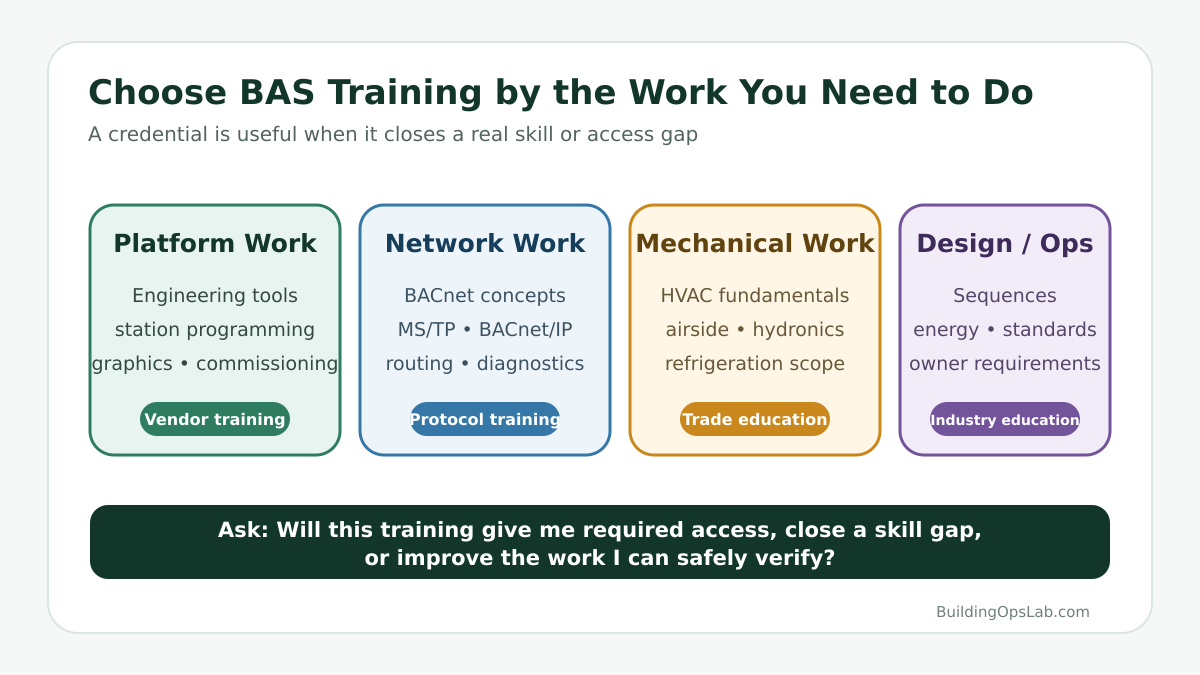
Before paying for training, ask three questions: Does this credential provide access required by the employer? Does it close a skill gap that appears in real service work? Will it improve the work you can safely test and verify? If the answer to all three is no, supervised field experience or a more targeted course may provide greater value.
What Employers Actually Need From You
A certification can help get an interview or qualify you for a platform, but service work still comes down to whether you can solve problems safely.
A strong controls technician should be able to:
- Read the sequence of operation
- Verify a field signal
- Trace a command path
- Troubleshoot an MS/TP or IP communication problem
- Commission a VFD or actuator interface
- Use trends to identify what changed first
- Document the final repair and verification
Collect credentials that support those abilities. Do not collect certificates simply because the title sounds impressive.
Certification vs License vs Product Certification
Keep these categories separate:
- Professional/vendor certification: validates a person’s knowledge or platform training.
- Trade license/certification: may recognize or authorize regulated work depending on jurisdiction.
- Course certificate: documents completion of training.
- BTL Certification: certifies BACnet products, not individual field technicians.
Key Takeaways
- There is no single universal BAS technician certification.
- Niagara certification is highly relevant when the job uses Niagara.
- BACnet Institute courses are excellent protocol education; BTL Certification is for products.
- EPA Section 608 matters in the U.S. when your work enters the refrigerant circuit.
- Red Seal is a major Canadian HVAC/R trade credential but is not BAS-specific.
- NATE supports broader HVAC technical credibility rather than BAS-platform programming.
- Choose credentials based on the equipment and platform you actually work on.
FAQ
What is the best BAS certification?
There is no universal best credential. For Niagara work, Niagara certification is directly relevant. For multi-vendor BAS networking, BACnet education is valuable. For HVAC/R service, trade and refrigerant credentials may matter more.
Is BACnet certification required to work on BACnet?
There is no single technician license required by the BACnet standard. BACnet International provides education through The BACnet Institute, while BTL certifies products.
Does EPA 608 make me an HVAC technician?
No. Section 608 proves the required refrigerant-handling certification for covered work. It does not by itself demonstrate complete HVAC service competency.
Do I need Red Seal to work in BAS in Canada?
Not universally. BAS roles vary, and trade requirements depend on the work and province/territory. Red Seal RACM is highly relevant for technicians performing HVAC/R trade work, including associated controls.
Should I get certifications before applying for a BAS job?
A relevant credential can help, but junior roles may also hire for aptitude, HVAC/electrical background, networking ability, and willingness to learn. Target the platforms used by employers in your market.
Related Articles
Sources & Further Reading
- Tridium University – Niagara Training and Certification
- Tridium – Niagara 4 Technical Certification Program
- BACnet International – The BACnet Institute
- U.S. EPA – Section 608 Technician Certification Requirements
- Red Seal – Refrigeration and Air Conditioning Mechanic
- NATE – Certification Getting Started
- ASHRAE – Building Controls Resources
Disclaimer: This article provides general commercial HVAC and building-automation information. Always follow manufacturer documentation, site-specific procedures, applicable codes, licensing rules, and safety requirements.