RTU Economizer Not Working? How to Diagnose Sensors, Dampers, and Control Logic
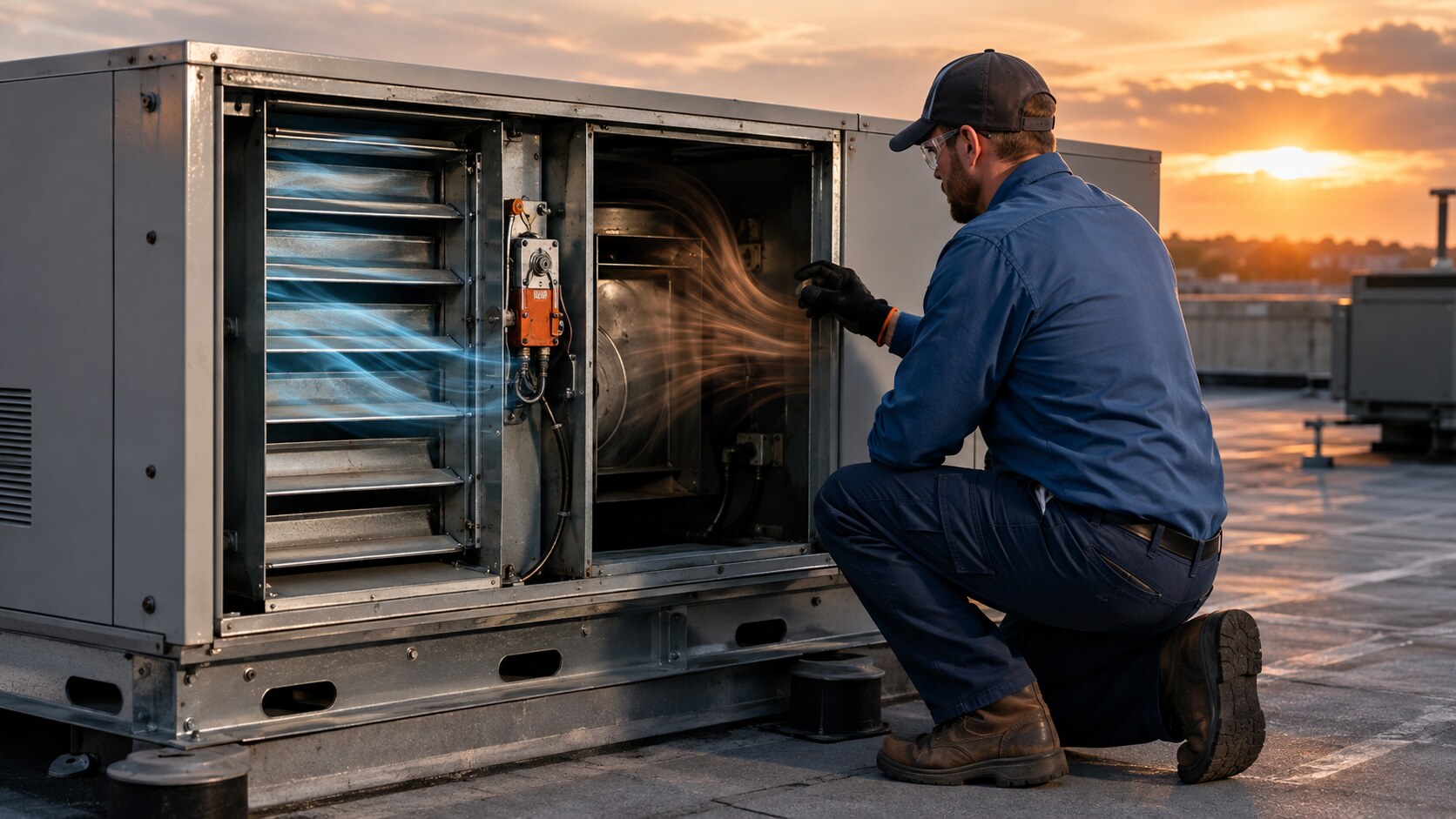
RTU economizer not working even when outdoor conditions look favorable? Follow the full control sequence—cooling demand, enable logic, sensors, damper command, physical movement, mixed-air response, and mechanical cooling—before replacing an actuator or controller.
Quick Answer
When an RTU economizer is not working, first determine which controller owns the sequence. Confirm cooling demand and economizer enable conditions, verify the sensors used by that specific unit, compare the BAS with the local controller, and then inspect the outdoor-air damper physically. Check minimum ventilation and integrated mechanical-cooling logic before changing configuration or replacing components.
Table of Contents
- Quick Troubleshooting Checklist
- The Problem
- Why It Happens
- How to Diagnose It
- How to Fix It
- Field Case: Economizer Retrofit Wiring Was Not Connected
- Tools Used
- Key Takeaways
- FAQ
Quick Troubleshooting Checklist
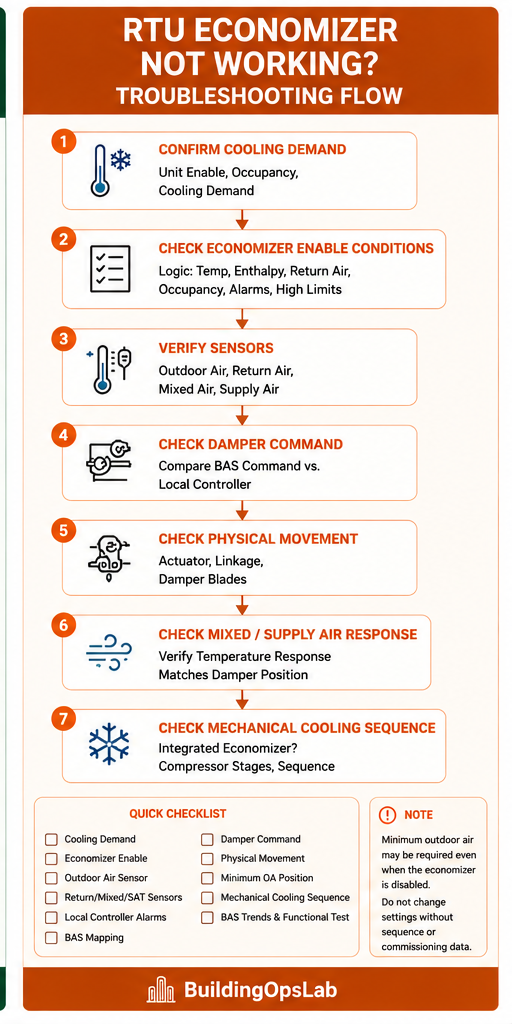
- Identify the controller that owns the economizer sequence.
- Confirm unit enable, occupancy, fan status, and cooling demand.
- Check economizer enable conditions and lockouts.
- Verify outdoor-air and other applicable sensors.
- Review local controller alarms.
- Compare BAS points with the local RTU controller.
- Check for BAS overrides and point-mapping errors.
- Compare damper command with physical movement.
- Confirm the approved minimum outdoor-air position.
- Watch mixed- or supply-air temperature response.
- Review the mechanical-cooling integration sequence.
- Trend and functionally test the completed repair.
The Problem
Outdoor conditions appear favorable for economizer operation, but the rooftop unit does not respond as expected. The outdoor-air damper may remain near minimum, an economizer-enabled indication may appear without physical damper movement, or compressors may run when the technician expects free cooling.
It is tempting to replace the damper actuator. That can be an expensive guess because an air-side economizer is a control sequence, not a single component. Its operation depends on sensors, controller configuration, occupancy and ventilation requirements, damper mechanics, BAS integration, and the unit’s mechanical-cooling logic.
The safest approach is to follow the sequence from the cooling request to the actual air-temperature response and identify the first point where expected behavior stops.
Why It Happens
Common causes include:
- Incorrect outdoor-air sensor reading
- Failed temperature, humidity, or enthalpy sensor
- Incorrect mixed- or supply-air feedback
- Economizer high-limit lockout
- Incorrect controller configuration
- BAS override or point-mapping problem
- Failed actuator or loose linkage
- Binding or damaged damper blades
- Incorrect minimum outdoor-air setup
- Economizer and mechanical-cooling sequence problems
- Controller power or communication problems
The actual sensors and enable logic depend on the RTU and economizer design. Some systems use dry-bulb temperature, some use enthalpy, and others compare outdoor and return-air conditions. Manufacturer documentation and the approved sequence of operation should take priority over assumptions based on another unit.
How to Diagnose It
1. Identify Who Owns the Economizer Sequence
Determine whether the logic resides in the RTU unit controller, a dedicated economizer module, the BAS/DDC controller, or a combination of these. This tells you where to find enable conditions, limits, alarms, configuration, and diagnostic values.
Do not assume that a BAS graphic owns the sequence merely because it displays the points. It may only be monitoring a local factory controller.
2. Confirm Cooling Demand and Operating Mode
Check unit enable, occupancy, supply-fan status, cooling demand, economizer available or enabled status, and applicable lockouts or high limits. Cool outdoor air alone does not prove the economizer should be active.
The controller may require a minimum cooling demand, an occupied mode, acceptable sensor status, or a particular outdoor-air condition before it allows damper modulation.
3. Verify the Sensors Used by the Actual Sequence
Depending on the design, check outdoor-air temperature, outdoor humidity or enthalpy, return-air conditions, mixed-air temperature, and supply-air temperature. Compare questionable readings with a reliable reference under stable conditions.
Look for sensor drift, failed sensors, incorrect scaling, wiring problems, poor placement, or incorrect BAS mapping. A believable value can still be wrong enough to hold the economizer outside its enable limits.
4. Compare the BAS With the Local RTU Controller
Compare economizer status, damper command, sensor values, cooling demand, controller alarms, and mechanical-cooling status between the BAS and the local controller. A mismatch can point to BAS mapping, stale communication, overrides, or a local-controller problem.
Also verify whether displayed percentages represent a calculated command, an actual feedback signal, or a mapped value with different scaling.
5. Verify the Damper Physically
A BAS value showing 100% outdoor-air damper may represent only a command. Inspect actuator movement, shaft connection, linkage, damper blades, and mechanical binding. Use the manufacturer’s approved checkout procedure where available.
Observe the damper through a controlled change rather than judging a single static position. Remove all temporary overrides after testing and return the unit to its approved operating mode.
6. Check Minimum Outdoor Air
Economizer disabled does not necessarily mean the outdoor-air damper should be fully closed during occupied operation. Minimum ventilation may still be required.
Do not change minimum position without checking the approved sequence, balancing or commissioning information, and applicable ventilation requirements. Reducing the setting to solve a temperature complaint may create an indoor-air-quality problem.
7. Review Mechanical Cooling Integration
Some RTUs use integrated economizer control. Outdoor air can provide part of the required cooling while compressors provide the remainder. Therefore, economizer active plus compressor running does not automatically indicate a fault.
Verify staging, discharge- or supply-air control, capacity limits, and lockouts against the actual equipment sequence before changing compressor or economizer settings.
8. Trend the Sequence
Useful trends include outdoor-air temperature, return-air temperature, mixed- or supply-air temperature, cooling demand, economizer enable, outdoor-air damper command, actual damper feedback if available, and compressor stages.
A particularly useful pattern is: economizer enables → damper command increases → mixed-air temperature does not respond. That narrows the investigation toward physical damper movement, airflow, actuator or linkage problems, sensor accuracy, or BAS mapping.
How to Fix It
Correct the failure confirmed by testing. Depending on the evidence, the repair may include:
- Repairing or replacing a confirmed bad sensor
- Correcting sensor scaling or BAS point mapping
- Removing unintended overrides
- Repairing actuator linkage or a binding damper
- Correcting economizer configuration
- Restoring controller power or communication
- Correcting minimum-air setup when approved commissioning data supports it
- Correcting economizer and mechanical-cooling sequencing
After the repair, functionally test the complete sequence. Confirm that enable logic changes correctly, the physical damper follows the command, air temperatures respond, ventilation minimums remain intact, and mechanical cooling stages as designed. Do not stop simply because an alarm disappears.
Field Case: Economizer Retrofit Wiring Was Not Connected
At one commercial building, a damper retrofit had been completed, but the actuator control wires were not connected. The BAS sequence and command could be reviewed from the workstation, yet neither one proved that the outdoor-air dampers could physically respond.
Onsite inspection identified the missing field connection. Because the problem was associated with the retrofit installation, it was treated as a warranty or contractor-correction item rather than an immediate controller-replacement decision.
This case shows why economizer diagnosis must cross the software-to-field boundary: verify the enable logic, confirm the output signal, inspect the actuator wiring, watch the linkage and blades move, and then confirm that mixed- or supply-air temperature responds. A correct graphic command is only one piece of the evidence.
Tools Used During the Investigation
- BAS trend and override tools
- Local RTU or economizer-controller interface
- Calibrated temperature and humidity instruments as required
- Digital multimeter used by qualified personnel
- Manufacturer checkout procedure and sequence of operation
- Balancing or commissioning documentation
- Flashlight and safe visual inspection tools
Key Takeaways
- An economizer is a complete control sequence, not just an actuator.
- Cool outdoor air alone does not prove that economizer enable conditions are satisfied.
- A BAS command does not prove physical damper position.
- Minimum outdoor air may still be required when economizer cooling is disabled.
- Compressors may legitimately run with an integrated economizer.
- Trend the command and temperature response to find where the sequence stops.
- Functionally test the complete repair before returning the unit to service.
Frequently Asked Questions
Why is the economizer not opening when it is cool outside?
Outdoor temperature may not be the only enable condition. The sequence may also consider cooling demand, enthalpy, return-air conditions, occupancy, sensor health, or manufacturer-specific limits.
Does a 100% outdoor-air damper command prove the damper is open?
No. Unless actual position feedback exists and is commissioned correctly, the BAS may display only the command. Verify movement at the actuator, linkage, shaft, and damper blades.
Should the outdoor-air damper close when economizer mode is disabled?
Not necessarily. Minimum outdoor air may still be required during occupied operation. Check the approved ventilation and control sequence before changing the minimum position.
Why are compressors running while the economizer is active?
The RTU may use integrated economizer control, where outdoor air and mechanical cooling operate together to satisfy the load or supply-air target.
Related Articles
- RTU Running but Not Cooling: What to Check
- AHU Static Pressure Alarm Troubleshooting
- VAV Box Not Cooling? What to Check Before Replacing the Controller
Technical References
- PNNL Best Practices for Air-Side Economizers O&M
- U.S. Department of Energy HVAC Commissioning
- Honeywell JADE W7220 Economizer Logic Module
Disclaimer
This article is for educational purposes only. Rooftop units contain electrical, mechanical, and moving hazards and can affect ventilation and life-safety-related building operation. Follow site procedures, lockout/tagout requirements, manufacturer instructions, applicable codes, commissioning documents, and qualified-person requirements.