RTU Running but Not Cooling? Check These 6 Things Before Calling for Service
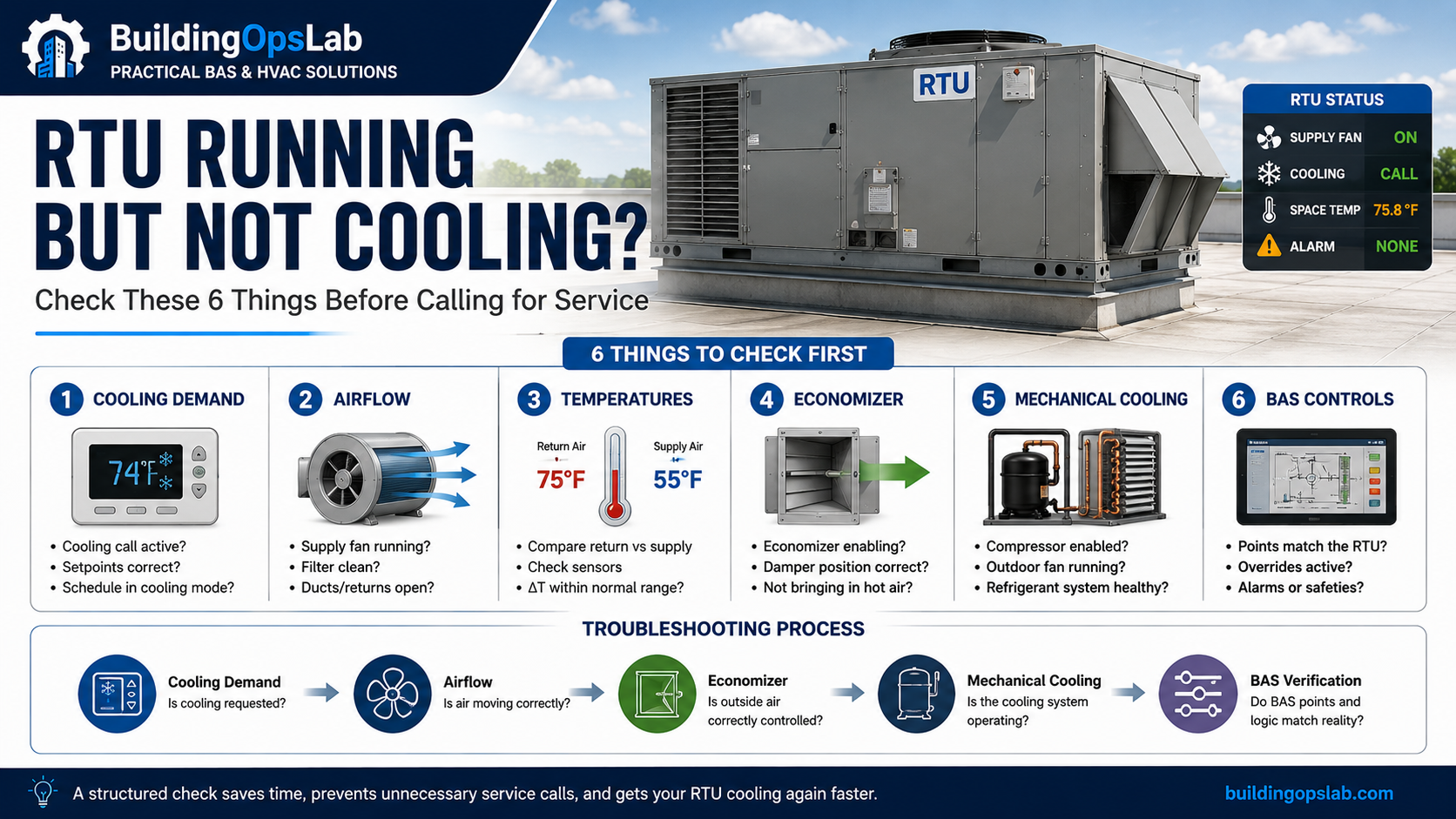
The rooftop unit is running. The supply fan is on. There may not even be an obvious alarm. But the space temperature keeps climbing.
It is easy to jump straight to the compressor or refrigerant circuit. That may eventually be where the problem is, but a commercial RTU combines airflow, economizer operation, sensors, controls, safeties, and mechanical cooling. Carrier’s own RTU service training separates these areas during troubleshooting for the same reason.
A better approach is to work through the cooling sequence in order and let the operating data narrow the problem.
Quick Answer
If an RTU is running but not cooling the space, check these six areas:
- Cooling demand and schedule
- Supply fan and airflow
- Temperature response
- Economizer operation
- Mechanical cooling status
- BAS commands, sensors, and actual field operation
What to Check First
☐ Is the space above the active cooling setpoint?
☐ Is the unit occupied or otherwise enabled?
☐ Is the supply fan actually moving air?
☐ What are the space/return and supply-air temperatures?
☐ Is the economizer being commanded, and is the damper responding?
☐ Is mechanical cooling being commanded?
☐ Are there active alarms or lockouts?
☐ Does the BAS display match what the unit is physically doing?
1. Confirm the RTU Is Actually Being Asked to Cool
Start with the sequence, not the compressor. Verify space temperature, active cooling setpoint, occupancy status, equipment schedule, and any temporary override.
A warm space does not automatically prove that the RTU should be in mechanical cooling. The controller may be in an unoccupied mode, economizer mode, demand-limited mode, or another sequence specific to the site.
2. Verify the Supply Fan and Airflow
Cooling performance depends on airflow. Check the fan status, actual air movement, accessible filter condition, fan or VFD alarms, and obvious damper restrictions.
Do not assume every RTU uses the same fan arrangement. Some use belts, some use direct-drive fans, and some use ECM or VFD control. Identify the equipment before applying a generic mechanical checklist.
A BAS fan status is useful, but it does not prove that the correct airflow is reaching the occupied space.
3. Compare Temperatures—Do Not Rely on One Number
Review space or return-air temperature, supply-air temperature, outdoor-air temperature, and the current operating mode together.
Avoid using a single generic supply-air temperature or temperature difference as a universal pass/fail rule. The expected response changes with airflow, outdoor conditions, load, economizer position, compressor staging, and RTU design.
The useful question is whether the temperature response makes sense for what the controller says the unit is doing.
4. Check the Economizer
Economizer faults can create comfort and energy problems even when the rest of the unit appears to be running. DOE commissioning guidance specifically calls for checking outside-air dampers and economizer controls on systems that use them.
Review, where available:
- Outdoor-air damper command
- Damper feedback or actual actuator position
- Outdoor-air sensor
- Return-air sensor where the sequence uses it
- Economizer enable status
- Mechanical-cooling interaction
Command is not feedback. A graphic can show a damper command while the actuator, linkage, or physical damper is not moving.
5. Determine Whether Mechanical Cooling Is Actually Operating
If cooling demand exists and the economizer cannot satisfy it, check whether mechanical cooling is being enabled and whether the unit responds.
At an operator level, useful information may include cooling-stage command, compressor status, active lockouts, and the supply-air-temperature response. A command alone does not prove that a compressor has started or that the refrigeration system is healthy.
Electrical testing, refrigerant pressures, safety-circuit diagnosis, and internal service procedures belong with qualified HVAC personnel.
6. Compare the BAS With the RTU
BAS integration adds valuable visibility, but it also adds another possible failure layer. A problem may exist at the RTU, in the controller, on the network, in the mapped point, or only in the graphic.
Common controls-side checks include:
- Incorrect or stale point values
- Sensor scaling errors
- Software overrides
- Schedule conflicts
- Communication interruptions
- Commands that do not match physical operation
Use Trends to See What Changed Before the Complaint
A live graphic shows what the RTU is doing now. A trend shows what changed before the room became warm.
Useful RTU trends may include:
- Space temperature and cooling setpoint
- Supply-air temperature
- Outdoor-air temperature
- Fan command/status
- Cooling-stage command/status
- Economizer command/feedback
- Occupancy status
If the complaint began around 1:00 p.m., review the period before 1:00 p.m. Did the cooling command disappear? Did the fan stop? Did the economizer move unexpectedly? Did a controller go offline? The sequence is often more useful than the final alarm.
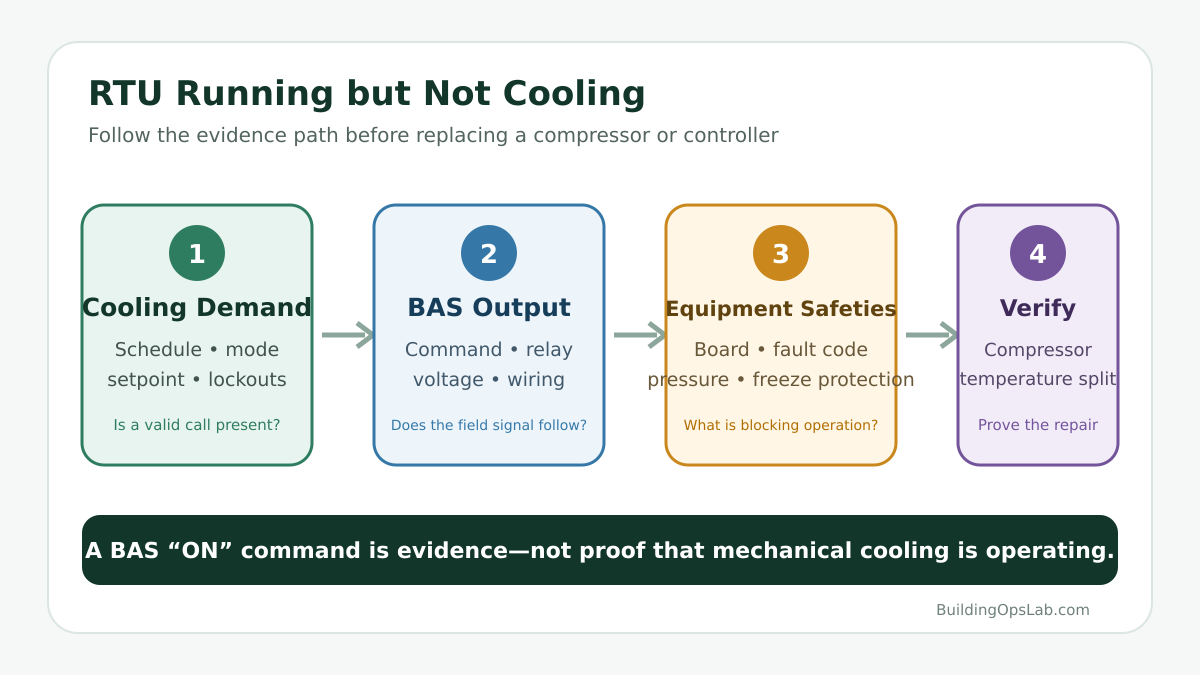
Field Case: BAS Command Present, Compressor Still Offline
At one commercial building, two compressors did not start even though cooling was required. The BAS review showed that the problem needed to be separated at the physical output rather than diagnosed from the graphic alone.
Onsite testing confirmed that the BAS start/stop relay voltage followed the controller command. That evidence moved the fault boundary downstream of the BAS output. One compressor returned after a reboot, while the second compressor control board continued to trip. The board indication and service information pointed toward an FP1/FP2 sensor-related fault. Wiring and board connections were checked and reseated, and the compressor started after the Y control connection was reconnected.
The unit was monitored after startup. The follow-up recommendation was conditional: if the fault returned, verify the failed component before replacing the compressor control board or related sensors. The important lesson is that a cooling command and an energized relay do not prove that the refrigeration circuit is operating. See the full compressor no-start troubleshooting case for the detailed BAS-to-equipment handoff.
What Facility Managers Can Check Safely
- Record the affected area and complaint
- Verify space temperature and active setpoint
- Review the equipment schedule
- Check BAS alarms and fan status
- Review available temperature and command trends
- Check economizer command/feedback if the BAS provides them
- Compare the graphic with visible equipment operation
Key Takeaways
- An RTU that is running but not cooling does not automatically have a failed compressor.
- Confirm the cooling demand before troubleshooting hardware.
- Airflow, economizer operation, mechanical cooling, and controls all need to be checked.
- A command is not proof of physical operation.
- Trends and command-path tracing can expose schedule, override, and communication problems.
FAQ
Why is my rooftop unit running but not cooling?
Possible causes include inadequate airflow, economizer or sensor faults, controls problems, mechanical-cooling faults, lockouts, or an incorrect operating command.
Can a dirty filter cause poor RTU cooling?
Restricted airflow can reduce performance, but filter condition is only one part of the airside check. Verify actual airflow and follow the unit manufacturer’s maintenance requirements.
Can the BAS show cooling ON when the compressor is not actually running?
Yes, depending on how the point is generated and mapped. A software command or network value may not be independent proof of physical compressor operation.
Should I reset an RTU that is not cooling?
Record the alarms and operating conditions first. If a safety or lockout returns, follow the manufacturer’s troubleshooting procedure rather than repeatedly resetting the unit.
Related Articles
Sources & Further Reading
• Carrier University — Troubleshooting Single Zone Rooftop Units
• Carrier — RTU Open Controller
• U.S. Department of Energy — HVAC Commissioning
Disclaimer: This article provides general commercial HVAC and building-automation information. Always follow manufacturer documentation, site-specific procedures, and applicable safety requirements.