AHU Freezestat Tripped but Cooling Is Still On: How to Check BAS Safety Interlocks

A freezestat trip is a safety event, not just another BAS alarm. When the field device has physically tripped, the control sequence should move the equipment into the protective state defined by the manufacturer and the site design.
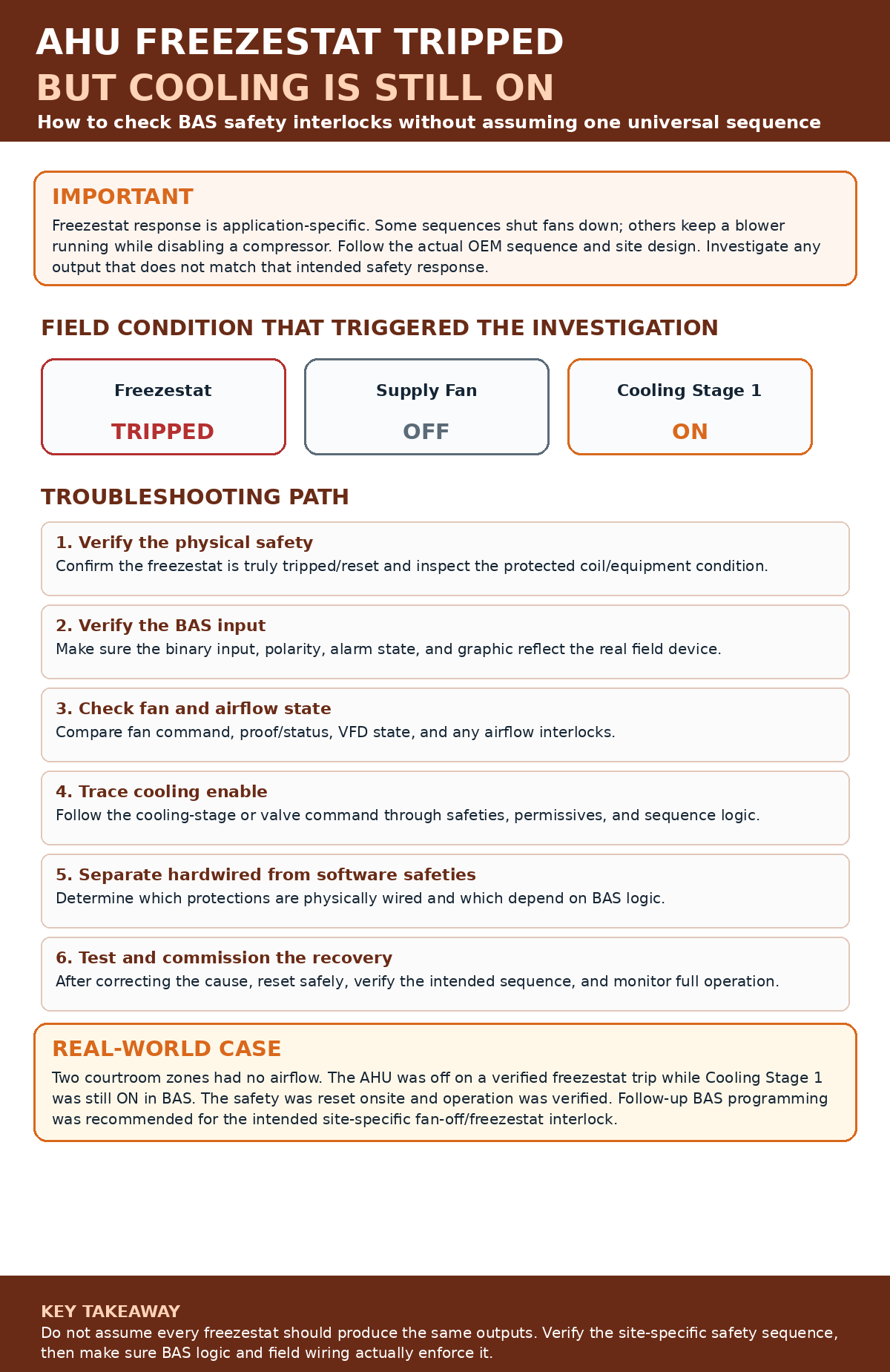
The difficult cases are the ones where the BAS states do not make sense together. For example: the freezestat is tripped, the supply fan is off, but a cooling stage still shows ON. That combination deserves immediate investigation because it may indicate a failed interlock, incorrect point mapping, a stuck output, or a sequence that is not enforcing the intended protection.
There is an important caution: freezestat sequences are not universal. Johnson Controls documentation shows different protective responses depending on the application. In some hydronic heating-coil sequences, a freezestat event can open the heating valve, close outdoor air, and shut fans down. In some cooling applications, a freezestat can de-energize the compressor while the indoor blower continues to run to help defrost the coil. Always troubleshoot against the actual equipment sequence.
Quick Answer
If a freezestat is tripped and cooling still appears enabled, do not start by resetting the alarm repeatedly. Verify the safety chain in this order:
- Confirm the freezestat is physically tripped and identify what it protects.
- Verify the BAS input matches the field contact.
- Check supply-fan command, proof/status, and VFD state.
- Trace the cooling-stage or cooling-valve enable through the sequence.
- Identify hardwired safeties separately from software interlocks.
- Check for overrides, stuck relays, or incorrect point mapping.
- After the cause is corrected, reset safely and commission the full protective sequence.
In This Guide
- Quick Answer
- Real-World Field Case: No Airflow, Freezestat Tripped, Cooling Stage Still On
- Remote Diagnosis or Site Visit?
- 1. Understand What the Freezestat Protects
- 2. Verify the Physical Safety Before Trusting the BAS
- 3. Compare Fan Command, Fan Proof, and Actual Airflow
- 4. Trace the Cooling Enable Through the Sequence
- 5. Separate Hardwired Safety from BAS Software Logic
- 6. Check for Overrides and Stuck Outputs
- Field Verification Matrix: Command, Proof, and Physical Result
- Safe Troubleshooting Workflow
- Commission the Complete Trip and Recovery Sequence
- What Facility Managers Can Check
- FAQ
- Key Takeaways
- Related BuildingOpsLab Guides
- Sources & Further Reading
- Safety Disclaimer
Real-World Field Case: No Airflow, Freezestat Tripped, Cooling Stage Still On
This anonymized service case separates what was seen remotely, what was confirmed onsite, and what remained follow-up work. It is not a completed commissioning report.
Remote investigation: a conflicting BAS state
Two courtroom zones reported no airflow. Remote BAS review showed the serving AHU stopped, the freezestat in a trip state, and Cooling Stage 1 displayed ON. These conflicting states justified onsite investigation of the safety and cooling-enable path. The ON indication alone did not establish that the compressor or cooling equipment was physically running.
Onsite finding and immediate recovery
An HVAC technician confirmed that the freezestat was physically tripped, reset the safety, and remained onsite to verify AHU operation afterward. The service record supports that immediate recovery; it does not provide the original trip cause, measured output voltage, compressor proof during the trip, or a defined follow-up monitoring period. The reset should not be read as proof that the underlying cause or every interlock was corrected.
Follow-up corrective action: recommended, not completed
A follow-up quotation was recommended to correct the BAS programming so mechanical cooling could not energize under the fan-off/freezestat condition intended at that site. Completion of that programming and a witnessed trip-and-recovery test are not documented in this case. They remain separate from the reported return to operation.
The diagnostic lesson
Treat a BAS command, a physical safety contact, and equipment proof as different evidence. First establish what each point represents, then compare the actual response with the approved sequence. Use the verification matrix and commissioning procedure below as a plan for your own installation, not as results already demonstrated by this case.
Remote Diagnosis or Site Visit?
Remote access can help define the problem and prepare an onsite visit. It cannot by itself confirm a manual-reset safety, relay state, or actual airflow. Do not remotely force cooling or bypass a safety to test this condition.
- Review remotely: capture the alarm sequence, point names, command versus proof labels, timestamps, overrides, and the approved control sequence. Treat missing or stale feedback as unverified.
- Arrange qualified onsite verification: when the physical trip state, final output, fan operation, or equipment condition cannot be established, follow the site escalation procedure. Do not call the equipment safe solely because the BAS screen looks normal.
- Before going to site: identify the AHU and affected zones; obtain the equipment model/manual, safety wiring diagram, approved sequence, alarm screenshots, and available trends. Confirm access and coordinate with the responsible HVAC technician.
- Prepare for the actual scope: arrange the required PPE and isolation procedure, BAS access and an appropriate backup, and instruments suitable for the authorized checks. Electrical testing belongs to qualified personnel following site procedures.
1. Understand What the Freezestat Protects
“Freezestat” can describe different low-temperature protection functions. It may protect a hot-water coil, a cooling coil, a packaged unit, or another section of an air-handling system. The expected response depends on that application.
Do not assume the supply fan must always stop, and do not assume the fan must always keep running. The correct answer comes from the OEM sequence, project control drawings, and site-specific programming.
2. Verify the Physical Safety Before Trusting the BAS
If safe and within your scope, confirm the physical freezestat state. A BAS alarm can be caused by a real trip, an open wire, incorrect input polarity, a failed input channel, or a mapping problem.
- Is the freezestat physically tripped?
- Is the contact normally open or normally closed in this application?
- Does the controller input change when the safety is reset?
- Does the graphic alarm correspond to the actual input object?
Do not bypass a safety to make the alarm disappear. If the physical condition that caused the trip has not been identified, resetting can expose the coil or equipment to further damage.
3. Compare Fan Command, Fan Proof, and Actual Airflow
Fan command and fan proof are different signals. A BAS may command the fan OFF and still show an old or incorrectly mapped status. Conversely, a VFD may be running locally even if the BAS command is OFF.
Check the command, VFD status, proof switch or current switch where provided, and actual airflow. If the protective sequence depends on fan proof, verify that the interlock uses the real proof point rather than only the software command.
4. Trace the Cooling Enable Through the Sequence
Cooling can be represented by a staged binary output, a chilled-water valve command, compressor enable, or a packaged-unit request. Follow the exact path from demand to final output.
- What condition normally enables cooling?
- Where is the freezestat inserted into that logic?
- Does fan proof also have to be true?
- Can a higher-priority override bypass the normal sequence?
- Is the BAS point showing command, status, or a calculated graphic state?
Older Johnson Controls AHU application guidance explicitly includes options for forcing cooling output to 0% during shutdown or loss of airflow. That illustrates the design principle: the sequence must define what cooling should do when the air system is not in a valid operating state.
5. Separate Hardwired Safety from BAS Software Logic
Some safeties are wired directly into compressor, starter, or enable circuits. Others are read by a BAS controller and enforced through software. Many systems use both.
A hardwired safety can stop the equipment even if the BAS command point still says ON. In that case the issue may be graphic semantics rather than unsafe physical operation. The opposite is more serious: if the equipment is physically energized when the intended safety condition should prevent it, the interlock path must be corrected.
6. Check for Overrides and Stuck Outputs
A software interlock can be correct but defeated by an override or by a failed field device.
- Check command priority or operator overrides.
- Check whether the controller output actually de-energizes.
- Check relay, contactor, or output module state.
- Verify the cooling stage point is mapped to the correct physical output.
- Confirm no local/hand mode is bypassing the BAS sequence.
Field Verification Matrix: Command, Proof, and Physical Result
This is a planning matrix, not measured results from the case above. Confirm each expected response against the installed equipment documentation and record the observed state, time, and test outcome separately.
| Point or Function | Expected BAS State During the Trip | Independent Verification |
|---|---|---|
| Freezestat input | Trip state is active and the alarm identifies the correct device | Confirm the field contact and manual-reset state without bypassing the safety |
| Supply fan | Command and sequence state match the documented protective response | Check VFD or starter status, fan proof, and actual airflow |
| Mechanical cooling | Cooling enable, stage, compressor request, or valve command follows the approved shutdown logic | Verify the output, relay or contactor, controller board, and physical equipment state |
| Outdoor-air damper | Command moves to the documented freeze-protection position | Inspect feedback, linkage, actuator, and actual blade position |
| Heating protection | Heating valve or pump response follows the site-specific sequence | Confirm valve position, pump status, flow, and temperature response where applicable |
Do not mark the interlock test complete because the BAS graphic changed color. A command, a feedback point, and the physical result are three separate pieces of evidence. If the BAS still shows cooling ON after a hardwired safety has de-energized the equipment, correct the point description or graphic semantics so operators can distinguish a request from proof.
Safe Troubleshooting Workflow
- Capture the alarm time and operating conditions before reset.
- Verify the physical freezestat and protected coil/equipment.
- Check controller input and alarm mapping.
- Check fan command, VFD state, and proof.
- Trace cooling enable and final output.
- Review hardwired safety circuits separately from BAS logic.
- Check overrides and local modes.
- Correct the root cause before repeated resets.
- Commission the sequence after repair, including trip response and recovery.
Commission the Complete Trip and Recovery Sequence
Use a planned, authorized test with qualified onsite personnel, the approved sequence, and manufacturer procedures. This procedure is recommended follow-up, not a claim that the field case completed these tests.
- Record the normal operating state, active commands, proofs, safeties, and temporary overrides.
- Initiate the approved freezestat test using the manufacturer and site procedure.
- Verify each protective output at the controller and at the field device.
- Confirm the alarm text, equipment association, timestamp, and operator instructions are accurate.
- Reset the safety only after the test condition and cause are understood.
- Verify recovery timing, fan proof, damper position, heating protection, and cooling re-enable logic.
- Remove every temporary force or override and review a follow-up trend for stable operation.
Record the actual response and any failed or unverified step. If the result differs from the approved protective sequence, follow the site escalation and safe-operating procedure; do not record a pass based only on an alarm clearing.
What Facility Managers Can Check
- Which AHU and zones are affected.
- Whether airflow is absent or only reduced.
- What alarms appeared first.
- Fan status, cooling status, and outdoor-air conditions shown in the BAS.
- Whether the condition started after maintenance, a cold-weather event, or a schedule transition.
Do not bypass freezestats, jump safety circuits, or repeatedly reset equipment without qualified troubleshooting.
FAQ
Should a freezestat always shut off the supply fan?
No. The intended response depends on the equipment and what the freezestat protects. Some OEM sequences shut fans down; other cooling-coil sequences may keep the blower running while disabling the compressor. Follow the actual manufacturer sequence.
Can the BAS show cooling ON even if a hardwired safety has stopped the equipment?
Yes. A BAS point may represent the software command rather than the actual physical output or equipment proof. Verify command, controller output, and field status separately.
Is it okay to reset a freezestat and see if it trips again?
Only after the cause and site procedure are understood. Repeated resets without diagnosis can expose the coil or equipment to damage.
What should be commissioned after a BAS interlock change?
Verify the trip input, protective output response, alarm indication, reset/recovery behavior, fan proof, cooling enable, and removal of any temporary overrides.
Key Takeaways
- A freezestat trip is a safety event, but the exact protective sequence is application-specific.
- Do not infer physical equipment state from one BAS graphic point.
- Separate command, proof, hardwired safety, and software interlock.
- Contradictory states such as fan OFF with cooling still commanded should be traced to the final output.
- After corrective work, commission both the trip response and recovery sequence.
For more symptom-based airside diagnostics, use the Commercial HVAC Troubleshooting Hub.
Sources & Further Reading
- Johnson Controls – Smart Equipment Controls: Freezestat Alarm
- Johnson Controls – Premier Packaged Rooftop Units: Freezestat Alarm
- Johnson Controls – AHU Applications Application Note: Cooling Shutdown / Loss of Airflow
- Johnson Controls – Packaged Unit Freezestat During Cooling Operation
Safety Disclaimer
This article provides general commercial HVAC and building-automation information. Always follow manufacturer documentation, site-specific procedures, and applicable safety requirements.