Why Your Commercial Chiller Keeps Alarming (And What to Check Before Calling for Service)
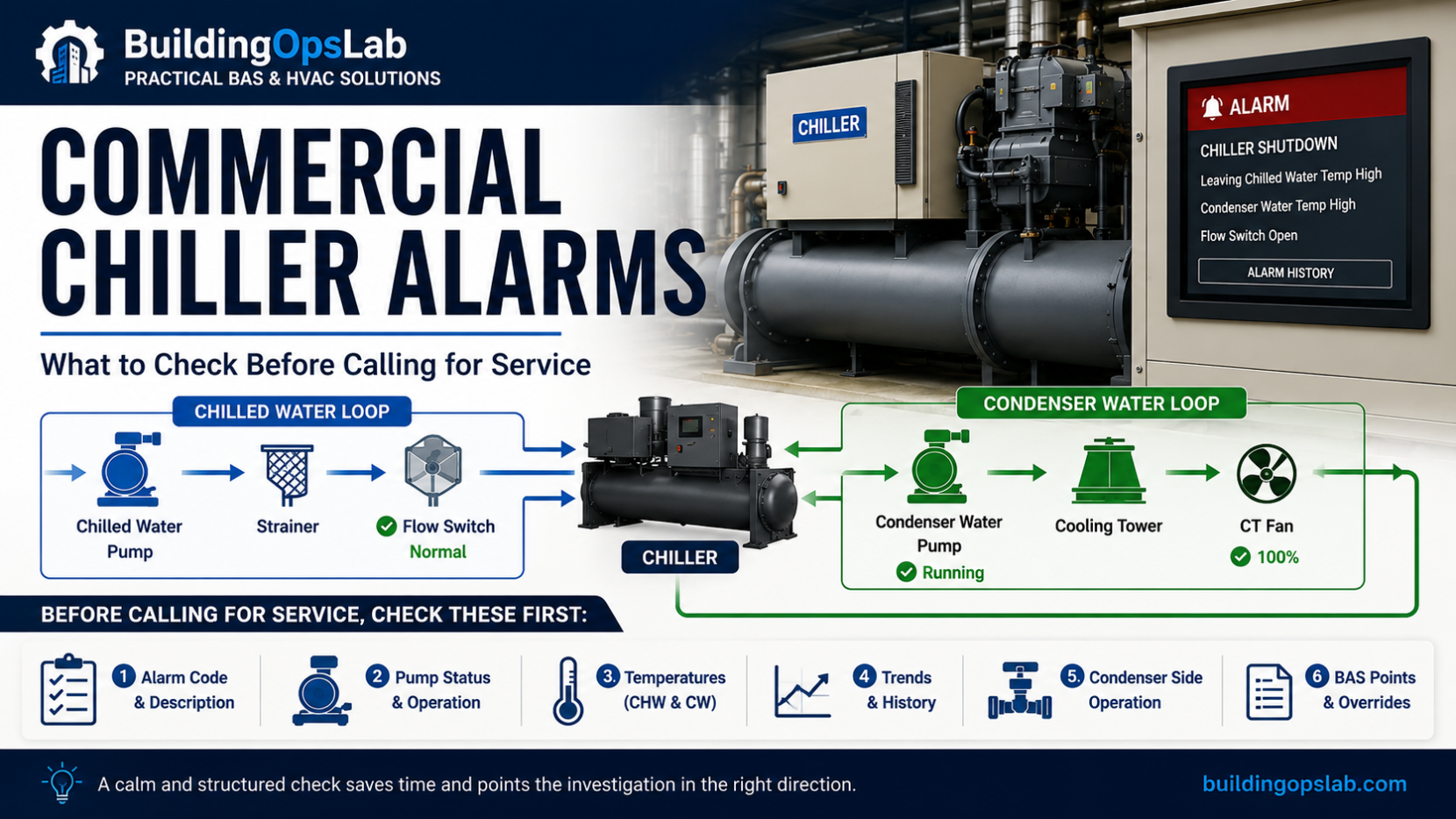
A chiller alarm gets attention fast. Operators see a failure on the BAS, comfort complaints may start coming in, and the natural reaction is to focus on the chiller itself.
Sometimes that is exactly where the fault is. But a commercial chiller works as part of a larger plant. Chilled-water pumps, control valves, sensors, flow conditions, and—on a water-cooled plant—condenser-water pumps and cooling towers all affect how the chiller operates.
That is why the fastest troubleshooting path is often to verify the system around the machine before assuming an internal refrigeration failure.
Quick Answer
When a commercial chiller keeps alarming or shutting down, start with four questions:
- What is the exact alarm at the chiller controller?
- Are the required chilled-water and condenser-water pumps actually operating?
- Do the BAS temperatures, pressures, commands, and statuses make sense?
- On a water-cooled plant, is the heat-rejection system operating as intended?
Avoid repeatedly resetting the alarm just to restore operation. Record the condition first, then investigate what caused it.
If the Alarm Is High Pressure
Record the exact alarm at the local chiller controller before resetting it. On a water-cooled chiller, verify condenser-water pump operation and flow, tower fan operation, entering condenser-water temperature, and the required valve positions. On an air-cooled chiller, check condenser-fan operation, coil condition, and airflow restrictions. Do not bypass safeties or repeatedly reset a high-pressure trip; use the model-specific service literature and qualified HVAC service to identify the confirmed cause.
What to Check First
☐ Exact alarm text or code at the local chiller controller
☐ Chilled-water pump command, proof, and VFD speed where applicable
☐ Chilled-water supply and return temperatures
☐ Differential pressure or flow information available to the BAS
☐ Required isolation and control-valve positions
☐ BAS communication and point quality
☐ Condenser-water pump and cooling-tower operation on water-cooled systems
1. Read the Alarm at the Chiller
Do not troubleshoot from a generic BAS alarm description alone. A graphic may show “Chiller Failure” or “Chiller Alarm,” while the local equipment controller contains the alarm code that actually matters.
Whenever it is safe and practical, record the manufacturer-specific alarm before resetting anything. Alarm logic, protective limits, and reset procedures vary by chiller model, so a generic alarm code should never be assumed to mean the same thing across different equipment.
2. Verify the Water Side
A chiller depends on the hydronic system around it. A pump can show an ON command while the actual flow condition is wrong, and a green status point does not prove that the evaporator is receiving the flow the manufacturer requires.
Review the available operating data together:
- Pump command and proof
- VFD speed or frequency
- Chilled-water differential pressure or flow
- Valve positions
- Supply and return temperatures
The exact acceptable flow range is equipment-specific. Use the chiller service literature and the approved sequence of operation rather than a generic rule of thumb.
3. Look at Supply and Return Temperatures Together
A single chilled-water temperature rarely tells the complete story. Compare leaving-water temperature, entering-water temperature, active setpoint, and the historical trend.
Do not treat 44°F (6.7°C), 42°F (5.6°C), or any other common design value as the universal operating setpoint. Chilled-water temperatures vary with the design, load, controls strategy, and equipment requirements.
What matters during troubleshooting is whether the temperatures are behaving logically for the current operating mode and whether the chiller is controlling toward the site’s intended setpoint.
4. Do Not Ignore Differential Pressure
In many variable-flow plants, pump speed is influenced by differential pressure. As valves open and close, the distribution system changes and the pumps respond.
If differential-pressure feedback is unstable, incorrectly scaled, or being controlled poorly, pump speed and system flow can become unstable. That does not mean every chiller alarm is a differential-pressure problem. It simply means the distribution loop is worth checking before the investigation becomes narrowly focused on the refrigeration circuit.
5. Water-Cooled Chiller? Check the Condenser Side
For a water-cooled chiller, the heat-rejection system is part of the same plant. Review condenser-water pump status, cooling-tower fan operation, tower VFDs, condenser-water temperatures, and active tower alarms.
A problem that first appears at the chiller can be influenced by conditions elsewhere in the condenser-water loop. If the evidence points toward the heat-rejection side, continue with the dedicated cooling-tower fan troubleshooting guide rather than treating every condenser-side symptom as an internal chiller failure.
6. Compare BAS Data With the Equipment
A BAS graphic is a powerful troubleshooting tool, but it is not automatically the source of truth. If the chiller controller shows normal operation while the BAS reports a fault, compare the mapped points with the actual equipment.
Possible BAS-side issues include:
- Lost or intermittent communication
- Stale values
- Incorrect point mapping
- Status logic that does not match the field wiring or network point
- Overrides or supervisory commands
Use Trends Before You Reset
The few minutes before a shutdown are often more useful than the few minutes after it. Trend the points that can explain the sequence of events: chilled-water temperatures, pump speed, differential pressure or flow, equipment enable, and condenser-water data where applicable.
If the alarm occurred at 2:17 p.m., look back before 2:17. Did a pump stop first? Did a temperature change suddenly? Did communication drop? Did a control point get overridden? The order of events is often the clue.
Field-Based Example: Follow the First Abnormal Event
At one commercial building, a chiller shutdown occurred while the associated cooling-tower fan VFD was observed running at full speed. That condition did not prove by itself that the drive caused the shutdown. Maximum fan speed can be a valid response to load or condenser-water temperature, and a BAS point may represent a command rather than physical proof.
The defensible troubleshooting step was to align the evidence by time: the exact alarm at the chiller controller, chiller enable and status, chilled-water pump proof, tower command and feedback, condenser-water temperatures, and any VFD fault or override. The combined evidence moved the investigation away from repeated resets and toward the connected heat-rejection system. The tower VFD was treated as a likely equipment-level fault requiring follow-up rather than as a confirmed cause based only on one BAS value.
After corrective work, verification should include a stable operating cycle with the original alarm absent and the relevant trend points behaving consistently. The detailed tower-side checks are covered in Cooling Tower Fan Problems, while the BAS trending guide explains how to put cause and response on the same timeline.
Minimum Evidence to Capture Before Resetting
- Exact OEM alarm text or code and occurrence time
- BAS alarm text, timestamp, and point quality
- Chiller enable, operating status, and active safeties
- Chilled-water pump command, proof, differential pressure, or available flow indication
- Chilled-water supply and return temperatures
- Condenser-water pump, cooling-tower fan, and VFD states on water-cooled plants
- Overrides, communication faults, and the last known normal operating period
What Facility Managers Can Check Safely
- Record the exact alarm and time of occurrence
- Review BAS alarm history and trends
- Verify pump commands and statuses
- Review chilled-water supply and return temperatures
- Review differential-pressure or flow information that is already available
- Check cooling-tower and condenser-water status on water-cooled systems
- Note whether the problem is isolated or recurring
Refrigerant pressures, compressor electrical testing, internal safety circuits, and manufacturer service diagnostics should be handled by qualified HVAC personnel.
Key Takeaways
- A chiller alarm does not automatically mean the chiller itself has failed.
- Start with the actual alarm at the equipment, then verify the water-side and heat-rejection systems.
- Commands and BAS statuses do not always prove physical operation.
- Trend data can show the sequence that led to the shutdown.
- Manufacturer documentation and the site sequence of operation take priority over generic values.
FAQ
Can a pump problem cause a chiller to shut down?
Yes. Chillers rely on appropriate water-flow conditions, but the exact protective response and acceptable limits are manufacturer- and model-specific.
Should I reset a recurring chiller alarm?
Not as the primary troubleshooting method. Record the alarm and operating conditions first. A recurring safety or fault condition should be diagnosed according to the manufacturer’s procedure.
Why does the BAS show a chiller alarm when the chiller is running?
The problem may be communication, point mapping, stale data, status logic, or another integration issue. Compare the BAS point with the local chiller controller.
Can a cooling-tower problem affect a water-cooled chiller?
Yes. The chiller and condenser-water system operate as an interconnected heat-rejection system. The exact effect depends on the equipment and plant design.
Related Articles
Sources & Further Reading
• ASHRAE — Fundamentals of Design and Control of Central Chilled-Water Plants
• Trane — Comprehensive Chilled Water Systems
• Carrier — TruVu ChillerVu Chilled Water System Optimizer
• ASHRAE Handbook — Condenser Water Systems
Disclaimer: This article provides general commercial HVAC and building-automation information. Always follow manufacturer documentation, site-specific procedures, and applicable safety requirements.