Commercial Boiler Short Cycling: What to Check Before Blaming the Boiler
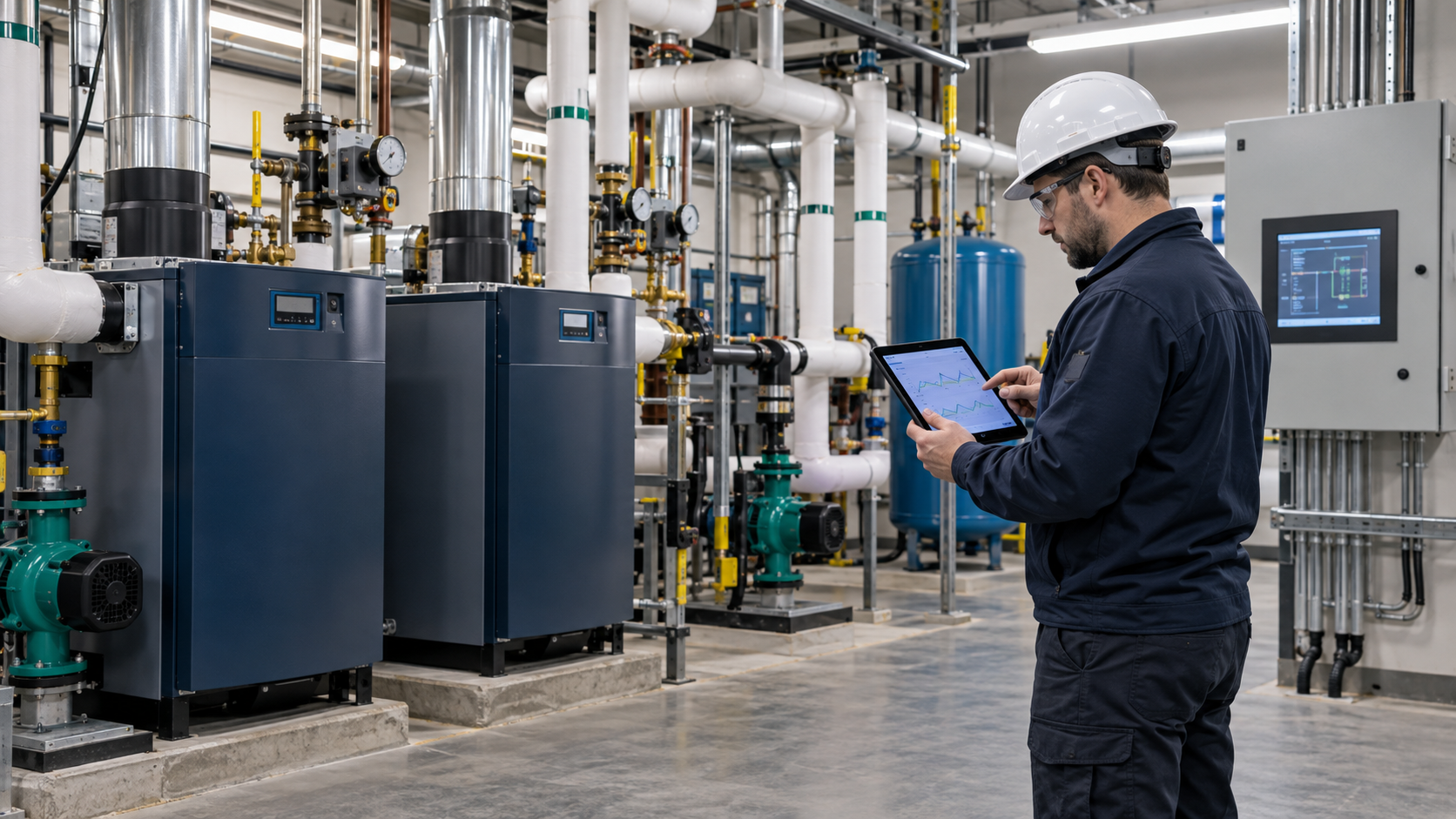
A commercial boiler that starts, stops, and restarts repeatedly can look like a burner or boiler failure. Sometimes the equipment itself is the problem. Just as often, the boiler is reacting to the system around it: too little active load, insufficient water volume, inadequate flow, unstable staging, an incorrect temperature signal, or a BAS sequence that does not match the plant design.
The useful question is not simply, “Why is the boiler cycling?” It is, “What condition is making the boiler satisfy its control target so quickly that it has to shut down again?” Answer that question before changing differentials, replacing controls, or condemning the boiler.
Quick Answer
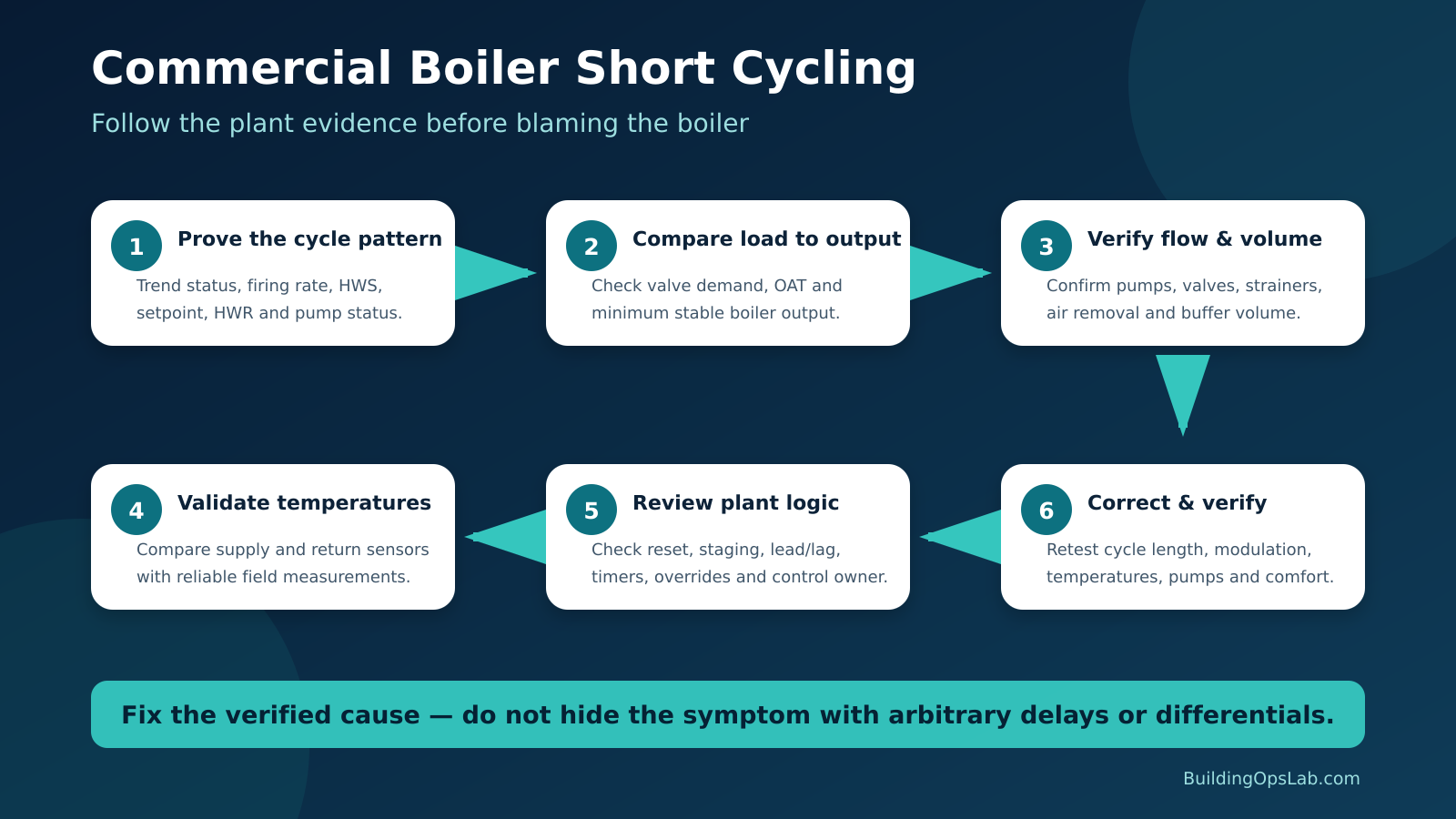
Prove the cycle pattern with BAS trends, then compare boiler output with active building load. Verify boiler and system flow, active water volume, temperature sensors, staging, reset logic, timers, and control ownership. Short cycling is often a plant-level symptom, not proof that the boiler itself has failed.
In This Guide
- The Problem: Short Cycling Is a System Symptom
- Common Signs of Boiler Short Cycling
- Why It Happens
- How to Diagnose Commercial Boiler Short Cycling
- How to Fix It Without Creating a New Problem
- Real-World Documented Example
- What Facility Managers Can Check Safely
- Boiler / BAS Technician Checklist
- Key Takeaways
- FAQ
- Field Evidence Worksheet
- Choose Your Next Diagnostic Step
The Problem: Short Cycling Is a System Symptom
Boiler cycling is normal. A heating plant must start, modulate, stage, and stop as building load changes. The problem is repeated short run times and frequent restarts that indicate the plant cannot operate steadily at the current load or under the current control conditions.
Short cycling can increase wear, create unstable water temperatures, reduce useful modulation time, and make operators chase nuisance alarms or comfort complaints. DOE/FEMP guidance recommends tracking boiler cycling when it appears excessive because cycling patterns can expose oversizing and control problems that are not obvious from a single BAS snapshot.
Do not diagnose the boiler from burner status alone. In a hydronic plant, the boiler, pumps, valves, system water volume, heating coils, reset schedules, outdoor-air conditions, and staging logic all influence how long each firing cycle lasts.
Common Signs of Boiler Short Cycling
Typical symptoms include a boiler that repeatedly fires for a short period, reaches its temperature target quickly, shuts down, and restarts soon afterward. BAS trends may show saw-tooth hot-water supply temperature, frequent burner-enable transitions, rapid lead/lag changes, or a boiler repeatedly reaching minimum firing before cycling off.
Why It Happens
1. The active load is below the boiler’s stable operating range
A boiler sized for peak winter conditions can still be too large for mild-weather or small-zone loads. Modulation helps only when minimum firing output is low enough for the load actually connected.
2. The system has too little active water volume
Low water volume gives the boiler less thermal mass to absorb heat. Some manufacturers specifically identify this as a short-cycling risk and recommend evaluating buffer volume when minimum boiler output exceeds the active load.
3. Boiler flow is inadequate or unstable
Pump problems, closed valves, blocked strainers, air, or an incorrect hydraulic arrangement can reduce heat transfer. Verify the installed boiler’s minimum-flow and piping requirements from its actual installation and operation manual.
4. Setpoint, reset, differential, or staging logic is wrong for the current load
The plant may satisfy too quickly, stage excess capacity, or cycle between states. Do not copy generic differential or staging values from another site.
5. A temperature sensor does not represent the real system condition
Bias, scaling, location, wiring, or an incorrect input type can make the boiler shut down or restart at the wrong time.
6. Load-side valves, pumps, and multi-boiler staging change the load seen by the plant
Rapid valve closure or unnecessary boiler staging can create the same cycling symptom as an oversized boiler.
How to Diagnose Commercial Boiler Short Cycling
Step 1 — Prove the pattern with a trend
Trend boiler enable/status, firing rate if available, hot-water supply temperature and effective setpoint, return temperature, pump status, lead/lag state, outdoor-air temperature, and representative heating demand. The BAS points-to-trend guide explains how to put command, process value, proof, safety, and load context on one time axis.
Step 2 — Identify the plant architecture and control owner
Confirm boiler type, pumps, primary/secondary arrangement, buffer tank, local cascade controls, BAS staging, and which controller owns enable and setpoint.
Step 3 — Compare minimum boiler output with the active load
If one boiler at minimum fire still raises water temperature quickly while most heating valves are nearly closed, investigate turndown, staging, and active load before tuning the loop.
Step 4 — Verify boiler and system flow
Check pumps, valves, strainers, air removal, differential pressure, and available flow measurement. Compare the piping and flow with the manufacturer’s requirements. If pump speed itself is unstable, use the HVAC pump-hunting diagnostic workflow before blaming the drive.
Step 5 — Check active water volume and zoning
A large plant feeding one small active zone may need different staging or thermal mass than the same plant at full occupancy. Confirm buffer-tank operation where applicable.
Step 6 — Review effective hot-water setpoint, reset, limits, and overrides
Reset can improve part-load operation, but the safe range depends on boiler type and distribution design. Non-condensing equipment may have minimum-temperature requirements. Broader reset and scheduling opportunities are covered in How to Reduce HVAC Energy Use in Commercial Buildings.
Step 7 — Review staging and lead/lag logic
Check stage-up/down timing, minimum run/off timers, number of enabled boilers, and whether BAS staging conflicts with a local cascade controller.
Step 8 — Verify supply and return temperature sensors
Compare BAS values with reliable field measurements. Confirm sensor type, scaling, wiring, location, and that each BAS point is current.
Step 9 — Retest under more than one load condition
Verify cycle length, temperature response, modulation, pumps, and comfort after the correction.
How to Fix It Without Creating a New Problem
The correction should follow the verified cause: restore required flow, correct sensor/input problems, repair pumps or valves, fix staging/reset logic, remove conflicting overrides, or address inadequate system water volume.
If the root cause is a capacity/load mismatch, the long-term answer may require different staging, better turndown, a smaller lead boiler, or added buffer volume. Those are design decisions, not generic BAS settings. When a graphic command does not match field operation, separate command, status, and proof using the BAS command-versus-feedback guide.
Real-World Documented Example: Trend Data Exposed Oversizing
DOE/FEMP documented a facility where five-minute runtime data revealed excessive boiler cycling. Investigation found the boiler had become grossly oversized after some building and process loads were decommissioned, and the recommendation was a smaller, properly sized boiler for the remaining load.
The lesson is the method: record the cycle pattern, relate it to actual load, and verify whether the plant has enough turndown and thermal mass to operate steadily. BAS trends can provide the same evidence when the relevant points are available.
What Facility Managers Can Check Safely
- Note whether the problem is worst during mild weather, nights, weekends, or low occupancy.
- Capture screenshots or trends showing boiler status and hot-water temperature together.
- Check whether multiple boilers are enabled when building load is low.
- Look for active overrides, unusual schedule changes, or recent renovations that changed heating load.
- Record comfort complaints that occur at the same time as the cycling.
- Do not change combustion, burner, safety, or manufacturer-protected parameters unless qualified and authorized.
Boiler / BAS Technician Checklist
☐ Trend boiler enable/status and firing rate where available.
☐ Trend hot-water supply temperature, return temperature, and effective setpoint.
☐ Record pump command/status and plant differential pressure or flow where available.
☐ Review representative heating-valve demand and outdoor-air temperature.
☐ Confirm which controller owns enable, setpoint, staging, and lead/lag.
☐ Verify the actual boiler model and manufacturer minimum-flow/temperature requirements.
☐ Check pumps, isolation valves, strainers, check valves, and hydraulic arrangement.
☐ Review active system water volume and buffer-tank operation where applicable.
☐ Verify reset schedules, differentials, timers, and staging without assuming generic values.
☐ Validate supply/return temperature sensors against field measurements.
☐ Retest after correction under more than one operating condition.
☐ Document the final sequence and any site-specific limits.
Key Takeaways
- Short cycling is often a plant-level symptom, not proof of a failed boiler.
- The first job is to prove the cycle pattern and compare it with load, temperature, flow, and staging.
- Low load, low water volume, inadequate flow, sensor error, and poor staging can produce similar symptoms.
- Manufacturer requirements take priority over generic cycles-per-hour, minimum-flow, or temperature rules.
- Fix the reason the boiler satisfies too quickly instead of hiding the symptom with arbitrary delays or differentials.
Frequently Asked Questions
How many boiler cycles per hour is too many?
There is no single universal number for every commercial boiler. Some manufacturer manuals publish model-specific recommendations, while DOE/FEMP examples use cycling frequency as a diagnostic indicator. Follow the installed boiler’s documentation and evaluate run time in the context of load and controls.
Can an oversized boiler cause short cycling?
Yes. A boiler whose minimum stable output is higher than the active building load can reach setpoint quickly and shut down. This can also happen when the building load has decreased since the plant was originally designed.
Can low water flow cause short cycling?
Yes. Several commercial boiler manufacturers identify minimum flow as essential for stable operation. Verify the actual model’s requirements, pump operation, piping arrangement, and system flow before changing BAS logic.
Will outdoor-air reset solve short cycling?
It can reduce unnecessary water temperature and improve part-load operation in appropriate systems, but it is not a universal cure. The allowable reset range depends on boiler type, distribution system, heating-coil requirements, condensation limits, and the approved sequence.
Should I add a buffer tank?
A buffer tank can increase thermal mass when active load and system volume are too small for stable run time, but sizing and piping are design tasks. Confirm the root cause first.
Choose Your Next Diagnostic Step
Choose the guide that matches the evidence you found. Each path addresses a different part of the system.
- Pump speed or flow is unstable: investigate the pump-hunting path.
- The cycle pattern is unclear: select related BAS points for a trend.
- The verified fault is corrected: review broader scheduling and reset opportunities.
- A boiler or pump graphic conflicts with operation: separate command, status, and field proof.
Browse the HVAC troubleshooting hub →
Sources & Further Reading
- U.S. Department of Energy / FEMP — Operations and Maintenance Best Practices Guide
- U.S. Department of Energy / FEMP — Purchasing Energy-Efficient Boilers
- Lochinvar — Power-Fin Boiler Designer’s Guide
- Lochinvar — Commercial Boiler IOM Example
- PNNL Building Re-Tuning — Large Building Guides
Disclaimer: This article provides general commercial HVAC and building-automation information. Always follow manufacturer documentation, site-specific procedures, applicable codes, lockout/tagout requirements, and safety procedures. Work on energized electrical equipment, combustion systems, refrigerant circuits, steam, and safety controls should be performed only by qualified and authorized personnel.