HVAC Pump Hunting: Why Your VFD Pump Keeps Speeding Up and Slowing Down
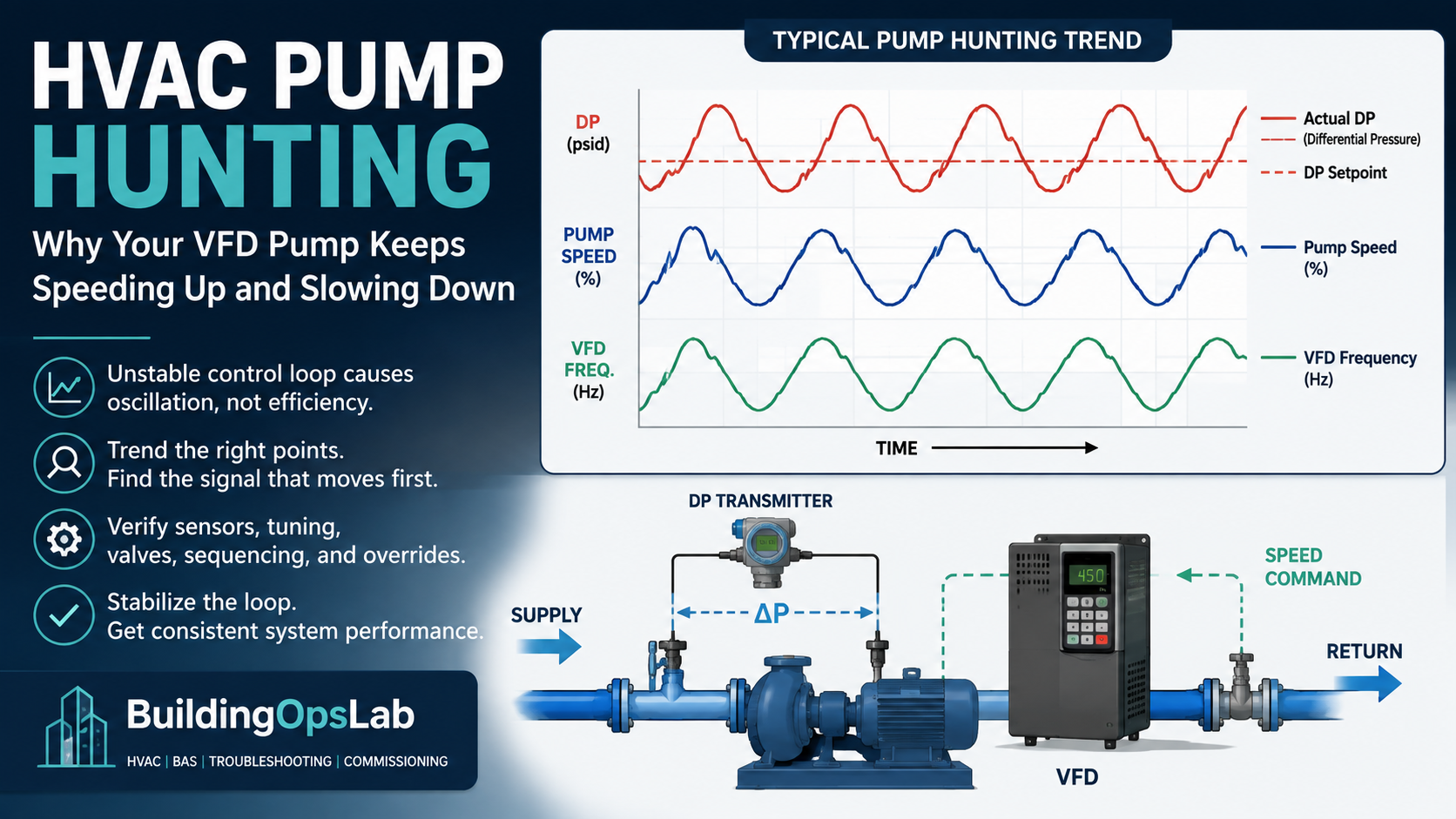
HVAC pump hunting occurs when a variable-speed pump repeatedly speeds up and slows down instead of settling at a stable operating point.
Operators usually call this pump hunting. Because the changing speed is visible at the VFD, the drive is often blamed first. But the VFD may be doing exactly what the control system is telling it to do.
In variable-flow hydronic systems, pump speed, differential pressure, control valves, sensors, and sequencing interact. Troubleshooting works best when those signals are reviewed together.
Quick Answer
Before replacing a pump or VFD, check:
- Differential-pressure feedback
- Pump speed command
- Control-loop output
- Sensor stability and scaling
- VFD operating mode and limits
- Control-valve activity
- Lead/lag or staging logic
- BAS overrides and programming
The most useful first tool is often a trend log. Trend the controlled variable, setpoint, and pump output together and identify which signal moves first.
What to Check First
☐ Is the pump actually hunting, or is the BAS speed display incorrect?
☐ Is the VFD in the intended automatic/remote mode?
☐ Does actual VFD speed follow the BAS speed command?
☐ Is the differential-pressure signal stable and believable?
☐ Is the loop output oscillating?
☐ Are valves or other pumps changing at the same time?
☐ Is another controller or override influencing the command?
What HVAC Pump Hunting Looks Like
Normal variable-flow operation includes speed changes. As two-way valves open, system differential pressure tends to fall and the pump speeds up. As valves close, pressure rises and the pump slows down.
Hunting is different. The system repeatedly overshoots and corrects without settling even though the building load is relatively steady. Pump speed may swing up and down while differential pressure follows the same repeating pattern.
The question is not “Why is the VFD changing speed?” It is “What signal is making the VFD change speed?”
1. Trend Differential Pressure, Setpoint, and Pump Speed Together
Looking at pump speed alone does not explain the problem. If the loop controls differential pressure, trend actual pressure, pressure setpoint, speed command, and actual VFD speed together.
If differential pressure changes first and the pump reacts, the controller may simply be following changing system demand. If the controller output moves first, the pump responds, pressure overshoots, and the command reverses, the control loop deserves closer attention.
2. Verify the Sensor Before Tuning the Loop
A control loop cannot be more stable than the feedback it receives. Check for erratic readings, incorrect scaling, damaged or poorly connected pressure tubing where applicable, an inappropriate sensor range, or a BAS value that does not match an independent measurement.
Changing proportional or integral settings before verifying the input can hide the symptom or make the oscillation worse.
3. Determine Whether the VFD Is Following the Command
Compare:
- BAS speed command
- VFD reference source
- Actual VFD output frequency or speed
- Minimum and maximum limits
- Local/remote or hand/auto condition
- Active overrides
If the BAS command changes from 45% to 60% and the drive follows it, the drive may be responding correctly. Some HVAC drives also have their own PID and logic functions, so confirm whether the loop lives in the BAS controller, the VFD, a packaged controller, or another supervisory device.
4. Look at Valve and System Interaction
Terminal valves change the hydraulic system the pump is trying to control. If many valves open or close quickly, differential pressure changes and the pump responds.
The pump loop can also interact with lead/lag staging, bypass valves, minimum-flow logic, or another pump. What looks like bad tuning may actually be a sequencing problem.
5. Review the Control Loop—Without Guessing at Numbers
Depending on the controller, you may see proportional gain or band, integral time or reset rate, output limits, bias, or derivative settings. The terminology and algorithm vary by manufacturer.
There is no universal PID tuning value that can be safely applied to every system. Record the existing settings, understand the controller, make controlled changes only when needed, and verify the response under more than one load condition.
Real-World Field Case: Heating Pumps That Would Not Settle Down
At a commercial building, the operator reported that the heating pumps were hunting. Pump speed continued to move instead of settling into stable operation.
Investigation
Several operating scenarios were tested. The pumps were placed in the appropriate automatic condition, setpoints were changed, and the controller programming and BAS graphics were reviewed while the system response was monitored.
During the programming review, a PID tuning reset point associated with the controller was identified.
Corrective Action
The PID tuning point was reset and the pump response was monitored. After the reset, the pump speed stopped hunting. A daily schedule was then added to reset the PID loop as part of that site’s specific control strategy.
That scheduled reset is not a universal fix. It was used on this specific control system after the investigation identified the relevant reset function.
Additional Finding
During verification, the BAS graphic for Pump 1 speed was found to be incorrect. The graphic point was corrected so the displayed information matched the actual operating data.
The field lesson is straightforward: understand the command that is moving the pump before condemning the pump or VFD.
What Facility Managers Can Check
- When the hunting starts and how long it lasts
- Whether one or multiple pumps are affected
- Pump speed and differential-pressure trends
- Lead/lag status and active alarms
- Whether the problem appears only at certain loads or operating modes
Do not change VFD parameters or BAS tuning unless you are trained and authorized to do so.
Key Takeaways
- Variable-speed pumps are supposed to change speed; repeated oscillation without settling is the problem.
- Trend the controlled variable, setpoint, command, and feedback together.
- Verify the sensor before tuning the controller.
- Determine whether the VFD is generating the control action or simply following it.
- Check sequencing and valve interaction before assuming the loop alone is at fault.
- Site-specific fixes should not be copied to another building without understanding the control strategy.
FAQ
Does pump hunting mean the VFD is bad?
No. A VFD can be operating correctly while following an unstable command from the BAS or another controller.
Can differential-pressure control cause hunting?
Differential-pressure control is a normal method for variable-flow HVAC systems. Hunting can develop when sensor feedback, tuning, hydraulics, valve behavior, or sequencing create an unstable response.
Should I change the PID settings?
Not until the sensor, command path, operating mode, and existing tuning have been verified. Use the controller manufacturer’s documentation rather than generic tuning numbers.
Is a daily PID reset normally required?
No. The scheduled reset in the field case was a site-specific corrective action, not a general recommendation.
Related Articles
- Why Your Commercial Chiller Keeps Alarming
- AHU Static Pressure Alarm Keeps Coming Back? What to Check First
- VFD BACnet Integration: Why Start/Stop Commands Don’t Work
- Chiller Plant Optimization: Where BAS Technicians Should Look for Energy Waste
Sources & Further Reading
• Grundfos — How to Configure Pumping Schemes in HVAC Applications
• Grundfos — Control Modes for Maximum Savings
• Danfoss — VFDs for Commercial Building HVAC Fans and Controls
Disclaimer: This article provides general commercial HVAC and building-automation information. Always follow manufacturer documentation, site-specific procedures, and applicable safety requirements.